
| Name | SS Cap Arcona |
| Operator | Hamburg Süd |
| Yard Number | 476 |
| Code Number | RGLP |
| Builder | Blohm & Voss, Hamburg |
| Launch Date | 17th May 1927 |
| Sea Trials | 28th – 30th October 1927 |
| Maiden Voyage | 19th November 1927 |
| Tonnage | 27’561 GRT 15’011 NRT |
| Length | 205.9 meters |
| Width | 25.8 meters |
| Draught | 8.7 meters |
| Height of sides | 14.3 meters |
| Height from keel to mastheads | 63 meters |
| Installed Power | 24’000 hp |
| Maximum Power | 28’000 hp |
| Propulsion | 2 triple-expansion steam engines |
| Speed | 20 knots service (37.04km/h) 21 knots max (38.89km/h) |
| Crew | 630 |
| Passengers | 1st Class: 575 2nd Class: 275 3rd Class: 465 |
| Construction Cost | 35 million Reichsmarks (1927) $7.5 million (1927) |
| Nickname(s) | Queen of the South Atlantic Pearl of the Atlantic Flower of the Atlantic The Lucky Lady |
Chapter One: The New Flagship of the Hamburg Süd

This entire journey all started in 1926 a time when Germany was still recovering, at the gigantic Hamburg shipyard: “Blohm & Voss”. Inflation that had wrought the country since WW1 had stabilised since the introduction of the Rentenmark in 1924, and things were finally looking more hopeful. These bettering times of course applied to the Hamburg-Südamerikanischen-Dampfschiffahrts-Gesellschaft or Hamburg Süd, one of the premier German shipping lines. In 1925 they finally had begun to profit again after most of their fleet had been sunk or confiscated after WW1. This year they finally earned a profit of 1.7 million RM and with a shared capital of 20 million, the company was now planning to invest.

Hamburg Süd had two general managers: Theodor Amsick and John Eggert. Both of these men were put into a very difficult position to decide the future of the company after the recent positive developments. The Cap Polonio was their current flagship and very popular, but in need of a running mate as she could only complete a round trip to South America every two months. Other vessels in Hamburg Süd’s fleet like Antonio Delfino and Cap Norte lacked the necessary size, speed and luxury. They considered heavily the idea of building a new super- luxury liner, but the costs for that would be enormous.
Competition from other shipping lines was rapidly ramping-up and most higher ups believed the Cap Polonio would make-do against them. On the other hand, this contradicted the company’s successful business model of building a powerful leading flagship as they had done since 1904 with the Cap Blanco, and they might never get an opportunity like this again. Ultimately it was decided to go ahead with the project as without this flagship, Hamburg Süd would lose their spot as the number-one line on the South American service.
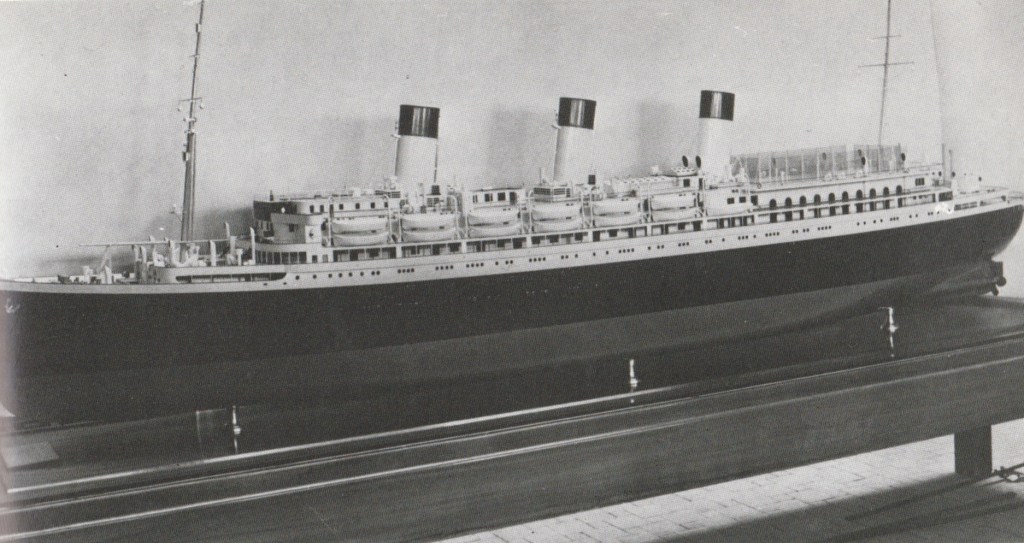
They began to plan a new ship, one that would eclipse all their others. It would be bigger than the Cap Polonio, more beautiful, more modern, more technical and more perfect. For fourteen months the technical department of the Hamburg Süd worked on this project, a ship that would especially appeal to the more wealthy clientele in Europe wishing to travel to South America. It would be better and faster than than all other ships on that route, sailing from Hamburg to Buenos Aires in fifteen days, and back home in fifteen more. With her three red and white funnels bearing the house colours of the Hamburg Süd, this would be the Cap Arcona, their magnum opus.
From Drawings to Reality:

Competition of the Cap Arcona
Hamburg Süd knew very well who their competitors were, and which ships they needed the Cap Arcona to outperform on the South America route. In 1925, they were already falling behind as Navigazione Generale Italiana had put the Guilio Cesare on the La Plata route, a magnificent vessel of 22’500 GRT as comapred to Cap Polonio’s 20’500 GRT. At the same time, Royal Mail Line in Britain had already put forward the orders at Harland & Wolff, Belfast for two more 22’000-ton liners: the RMS Asturias and Alcantara to serve this same route. Other contemporaries were Cosulich Società Triestina di Navigazione, looking to obtain a chunk of passengers sailing the La Plata route themselves, and then finally Compagnie de Navigation Sud-Atlantique were prepapring to build a 15’000-ton high-speed liner to be their stake on this service.
Onboard features of the new Cap Arcona
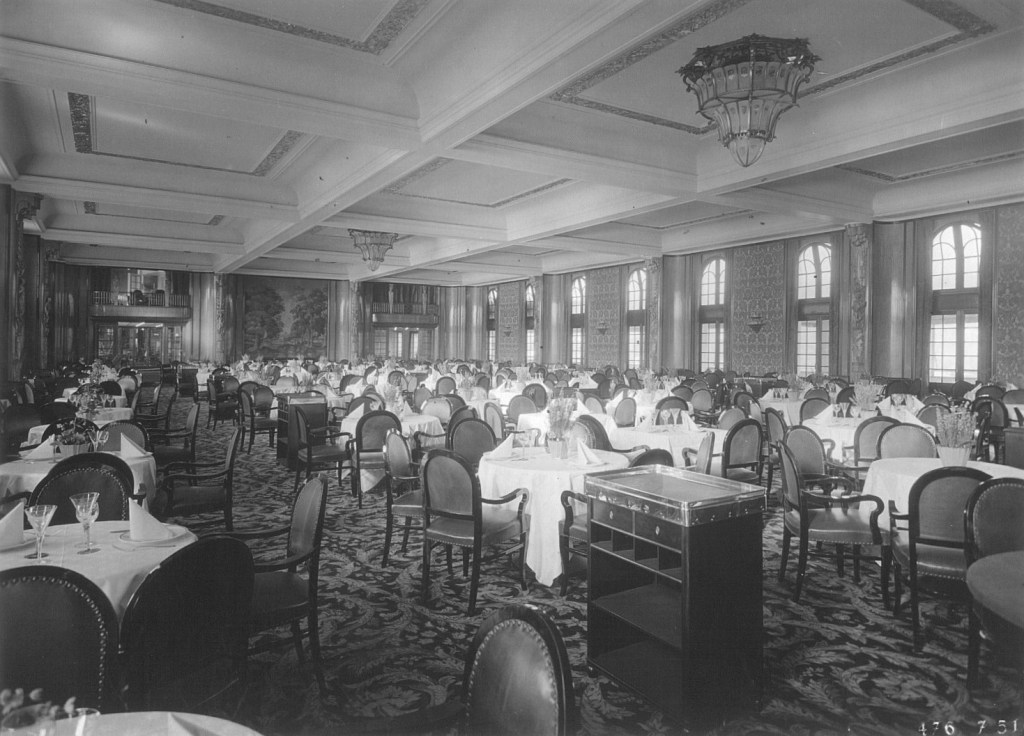
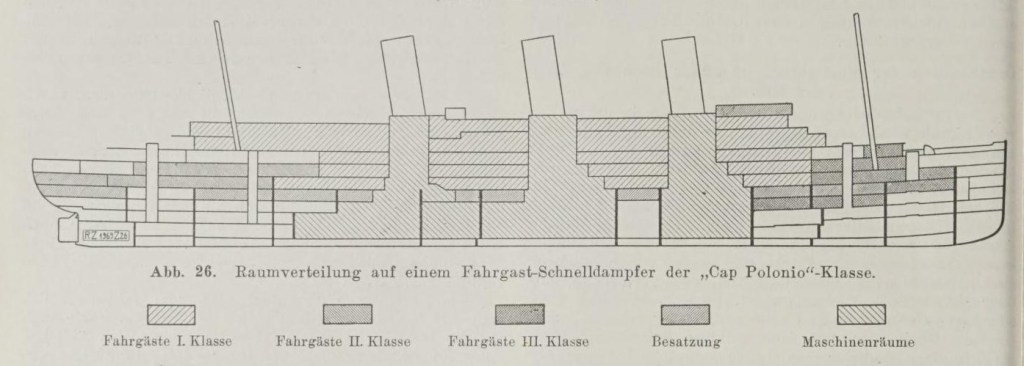
The new ship was built with the most modern and advanced knowledge technology of her day. To make her especially suitable to for service to the shallow harbour of La Plata, the ship was constructed with a low draught of 8.7m. This had effects on the length and width of the ship, which was to be equipped as an express liner with water-tube boilers and geared turbines. During pre-planning, passengers comfort was especially kept in mind. This new ship required optimal fittings and facilities for her 3 classes: In total the ship would carry 1434 passengers, all first class cabins had some access to daylight and private bathrooms with three passenger decks dedicated to them overlaid by the gigantic Dining Room. The Dining Room was placed here to allow the guests a fine view of the sea through any of the twenty, 5 meter-high windows that adorned the room. It followed the design of the previous Cap ships, being placed aft just like them.

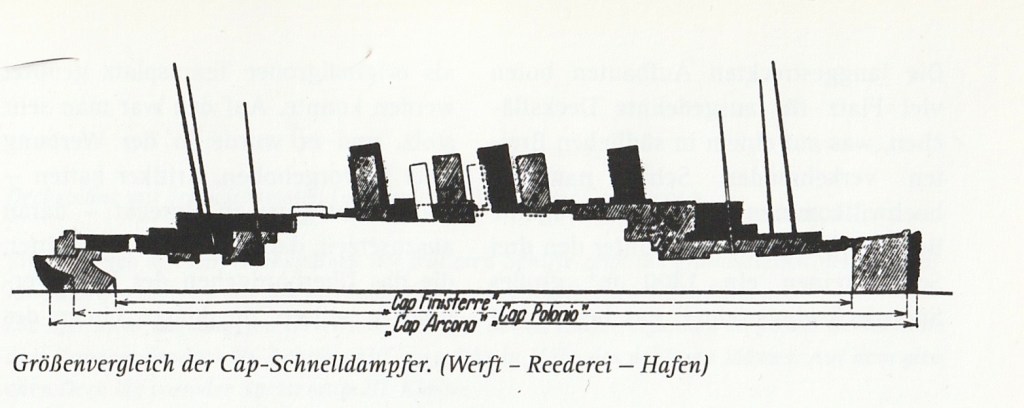
The Cap Arcona was specifically designed to be 7000 GRT and 2 knots faster than the Cap Polonio. The ship was only about 10 meters longer than her predecessor despite the massively-increased tonnage. The extra weight was made up for with the ship being much wider overall, forwards and aft. The cabins in the midst of the ship without access to portholes, were to be reserved solely for single passengers. The ones that had access to light were granted to those bunking with strangers, or travelling in groups. The Cap Arcona truly had an emphasis on light, and large open spaces. All her First Class public rooms – except for the Wintergarten and two private dining rooms, were located on the Promenade deck for maximum comfort. The phenomenal interior beauty of the vessel is attributed to the Berliner architect: HE Miritzt and the company: C. Friese.
In addition, a heated seawater swimming pool, Gymnasium, a colossal and very prominent Tennis court behind the third stack, a hospital, operating theatre and many more facilities were all provided onboard this ship and no other. As for the usual dreaded seasickness, the ship was built with a state of the art anti-rolling system for a more pleasant journey. All these features and comfort brought the construction costs to the financial limit, which very nearly made the ship over-budget. 21 million marks in 1926 was a gargantuan amount, but Hamburg Süd had full faith in their new flagship. With the perfect design finally realised, it was time to give the order to the most suitable shipbuilding firm.
Construction
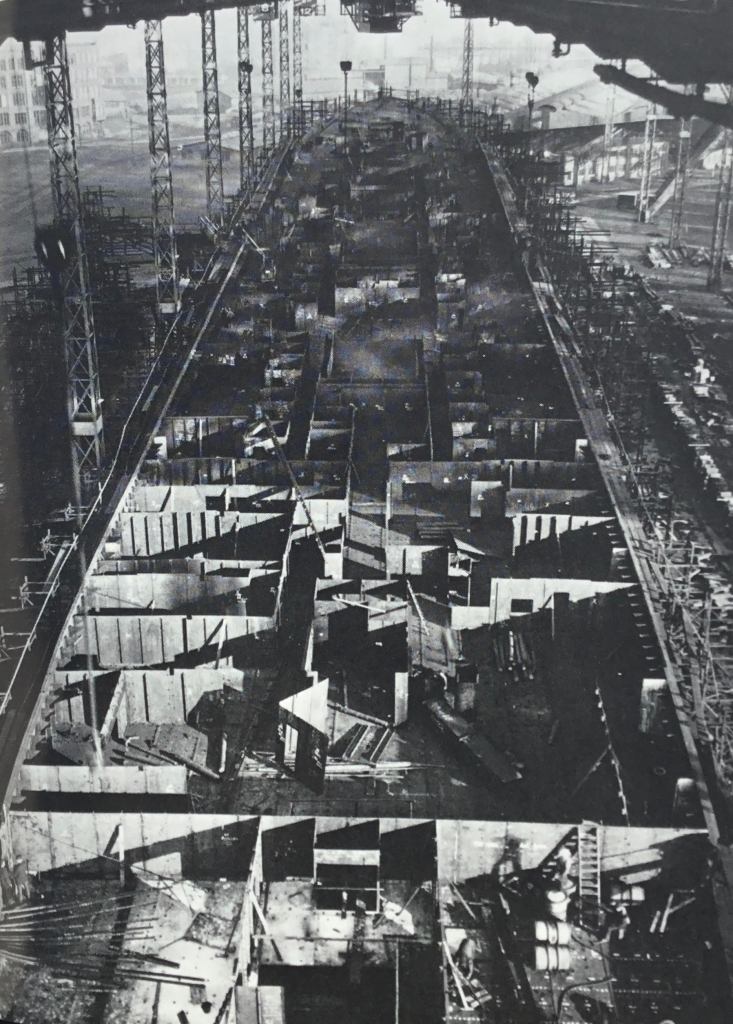
The head of Blohm & Voss shipyard at the time was Rudolf Blohm, son of the founder Hermann Blohm. He was well acquainted with the Hamburg Süd and knew all the intricacies of this new liner and all the special features and was more than happy to have the ship built by his company. As had most of Germany, Blohm & Voss had been in financial turmoil for some time and now this new job, could provide work for him and his employees for the next 20 months. Hamburg Süd had considered other places for the job, but one morning as Blohm entered the main building an employee came over to tell him someone was on the phone. He listened in, tense.. “We have the order!“. This was indeed a joyous occasion, as the job very easily could have been given to the Vulkan Shipyard in Szczecin. Obtaining an order was so competitive at the time, Vulkan would later sell one of its subsidiaries: AG Weser. With this massive job having been awarded to the shipyard, Blohm & Voss now boasted having the largest contracted tonnage to build for 1927.
Work swiftly began as there was no time to waste with the deadline and expectations Hamburg Süd had for the project. Construction had started on the 21st July 1926 and Hamburg Süd had wanted the ship launched mid-May the following year, sea trials in the second half of October and finally the maiden voyage in November to South America. In 15 months this ship must be ready to hit the water for the first time. The keel was laid and much hammering, riveting, knocking and humming would be heard from the site day after day as the hull took shape. Iron being cut lit up the rooms with a pale green colour, only for it to go out with a sudden bang. In the massive carpenters workshop, tables, chairs and bunks were fastened together, concrete being poured left much dust in the air, men climbed ladders hanging precariously on the rungs, all to get this new liner to her owners swiftly and efficiently before the approaching launch date.
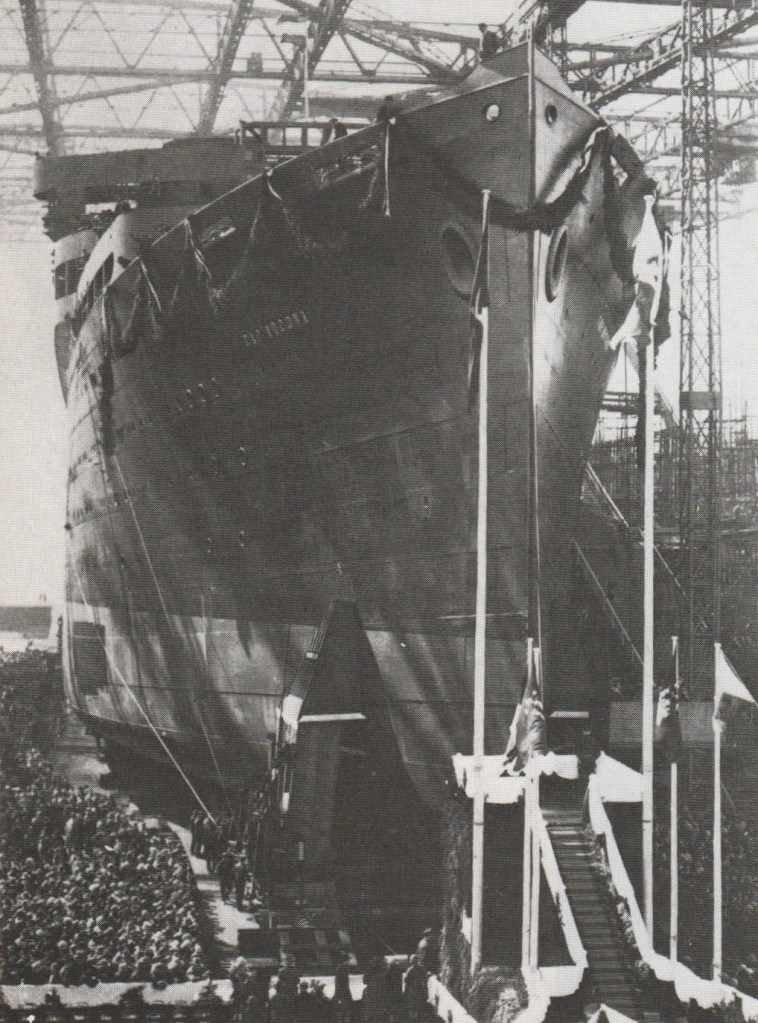
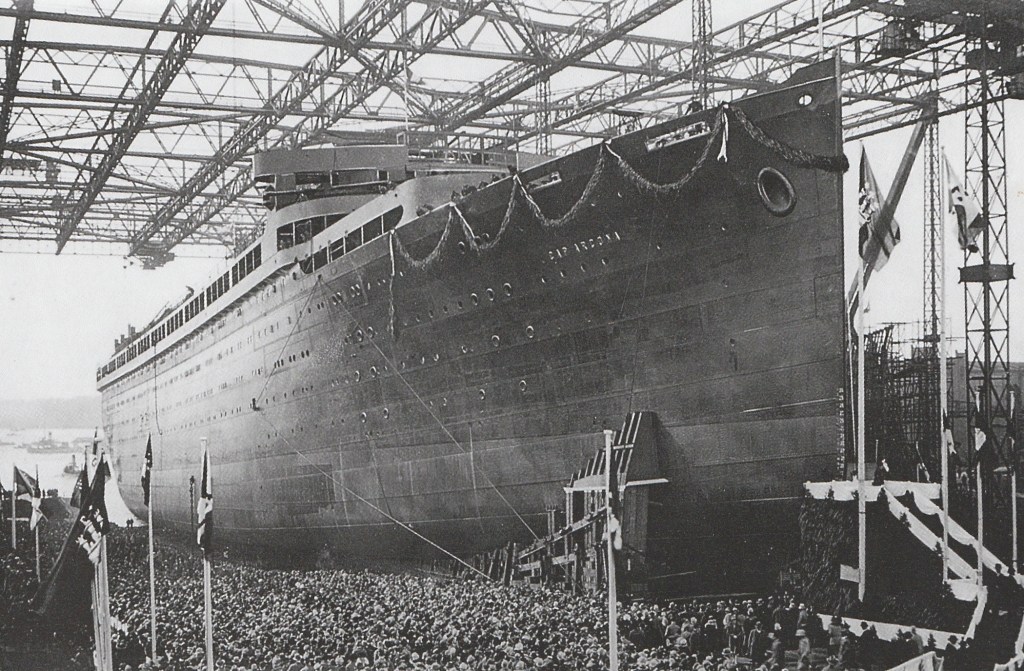
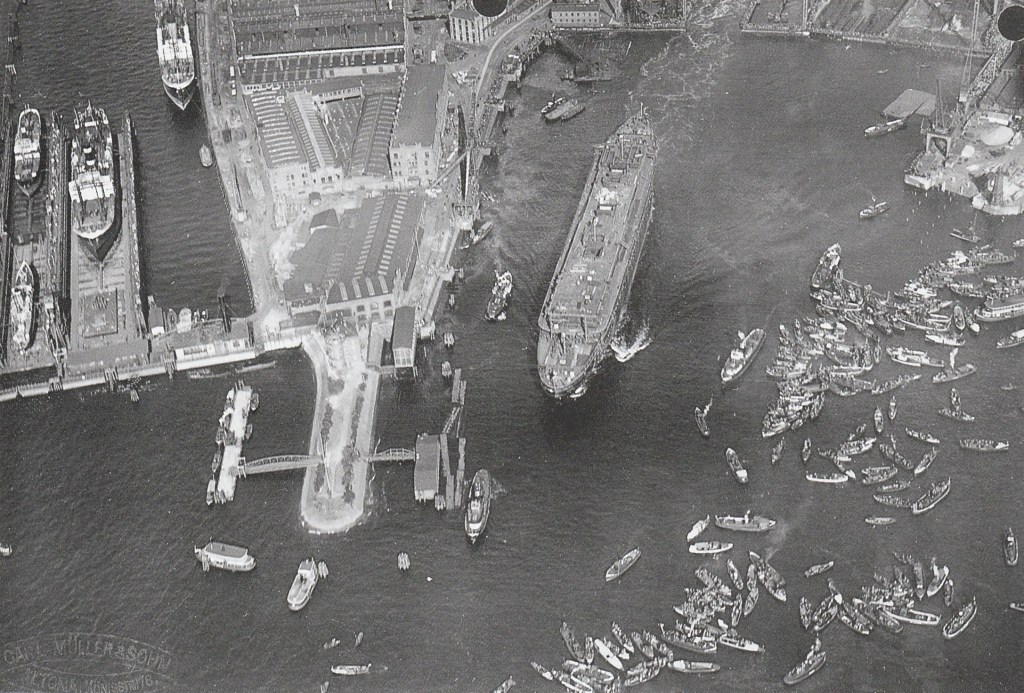
Soon the great day had arrived and all that hard work had paid off, the towering ship was finally ready to hit the water perfectly on schedule. The chief engineer of Hamburg Süd, Paul Müller had declared this ship to be “The most modern ship of the Hamburg Süd and the most technically-perfect passenger ship Blohm & Voss had built after the war“. It was Saturday, 17th May 1927, the clouds and rain in the early morning had gone down now and it was the afternoon. The ship had been completed for launch two weeks earlier on the 2nd of May. This event was of such magnitude, the largest ship launched in Hamburg since the war that every train line in the city was overflowing with a seemingly endless crowd of people all awaiting the launch. The people of Hamburg were very used to launches, but this one marked a very significant change, a symbol of bettering times and new hope as the newest, most beautiful German liner had arrived right now.
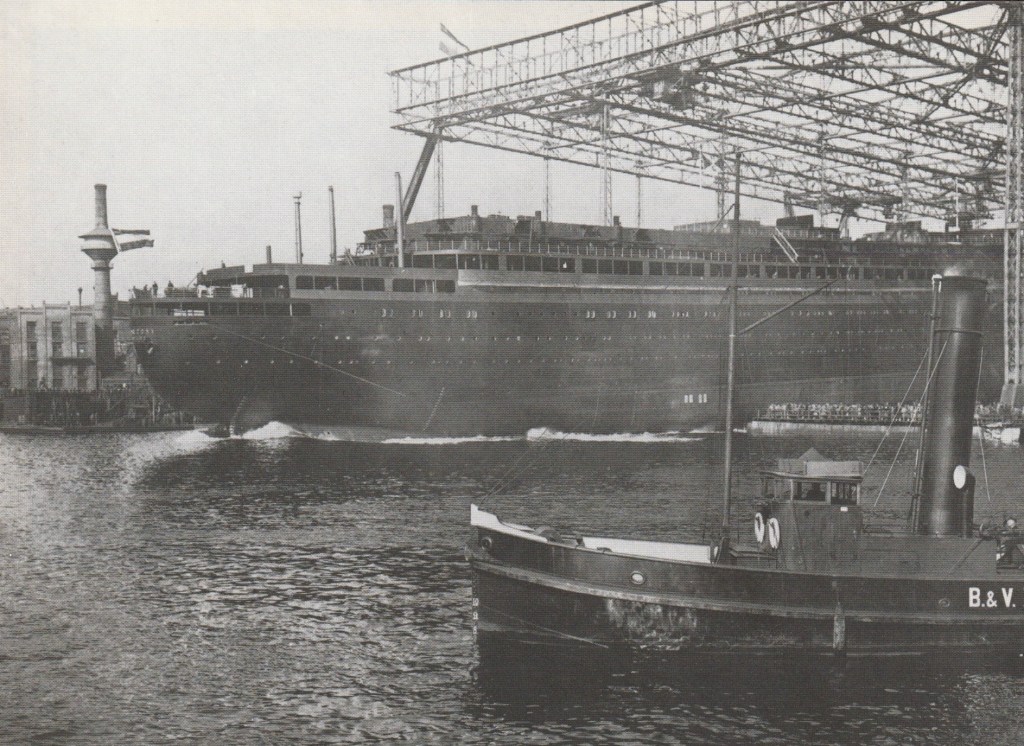
Out on the water, the river Elbe was absolutely packed with many small steamers eager for a good view all stuffed with as many people on board as possible to witness the much bigger one enter the water. The shipyard was a sea of flags with every inch taken up by people. Even the massive gantries over the ship used to build it were filled with workers watching their proud creation below. The time for the launch was 4 o’clock. When the time had arrived a very special person appeared on the stairs that led to a pulpit at the very bow of the ship. It was the young daughter of the general manager, Beatric Amsick to christen and launch the vessel. This little stage she stood on was even decorated with red & white ribbons. Her father Theodor Amsick was behind her alongside Rudolf Blohm and the board of supervisors of the Hamburg Süd and Blohm & Voss. The crowds were still and so she spoke:
“From the flood of the east sea north of the lovely island of Rügen, rises a rugged rock crowned with a lighthouse, that as the most important landmark of the east sea – shines its light far over the sea every night. The name of this rock, the only cap that adorns Germany’s coast shall be your name from now on. May you honour the beloved German Fatherland and to the delight of your owners, travel the seas and be a link between the Old and New World…
I name you Cap Arcona!“
And with that, at precisely 4 o’clock on Saturday 17th May 1927 a fine bottle of champagne smashed into the bow of the Cap Arcona and the hydraulic presses pushed the keel blocks the ship rested on towards the water. A young Brazilian girl jumped onto the pulpit waving a green flag of her homeland proudly and shouts to the crowd “Viva Alemanha!” (Long live Germany!) – to much applause. The ship was destined to sail to her homeland on its very maiden voyage but.. It hadn’t moved a millimetre so far. The crowds are quiet, some worried, all wondering why the ship was giving them this unexpected surprise. Until suddenly, a loud vibration occurred, transitioning into a series of groans, creaks and pounding as the ship moved slowly at first, but then quickly picking up speed sliding into the grey water of the harbour. A few minutes later, the colossus proudly floated in the water, awaiting its conversion into a luxury express steamship: the new flagship of the Hamburg Süd.
The Launch
- CHAPTER SELECT
- Chapter One
- Chapter Two
- Chapter Three
- Chapter Four

Bibliography
- Schön, Heinz (1989). Die Cap Arcona Katastrophe, Eine Dokumentation nach Augenzeugen-Berichten. Motorbuch Verlag
- Kludas, Arnold (1996) Die Cap-Schnelldampfer der Hamburg Süd, Königinen des Südatlantiks. Kohlers Verlagsgesellschaft mbH
- Kludas, Arnold (1989) Die Geschichte der Deutschen Passagierschiffahrt Band IV: Vernichtung und Wiedergeburt 1914 bis 1930. Ernst Kabel Verlag GmbH, Hamburg
- Marine engineering & shipping age, v.32 (1927) https://babel.hathitrust.org/cgi/pt?id=mdp.39015080127585&seq=371&q1=cap
 The Kaiserhafen