
Sea Trials
The maiden voyage of the Kronprinz Wilhelm was scheduled to take place between the 17th and 25th September 1901. Her sea trials were 10 days earlier and were undertaken during a special voyage to Bergen and Edinburgh between the 7 and 11th September. Being the running mate to the SS Kaiser Wilhelm der Grosse, the NDL was expecting that the Kronprinz reach at least 22.5 knots and nothing else. The failure of the SS Kaiser Friedrich had only happened two years prior and was very fresh on the minds of the NDL. Kaiser Friedrich had been built rather as an experiment, with her builders insisting her smaller size would mitigate her lower engine power and allow the vessel to reach 22 knots as per contract. Now was very bad timing as the SS Deutschland arrived a year later. She still held the Blue Riband and despite the Kaiser’s improving performances, she still held the speed record both ways.
Views of the Kronprinz Wilhelm on her sea trials in Bergen, Norway
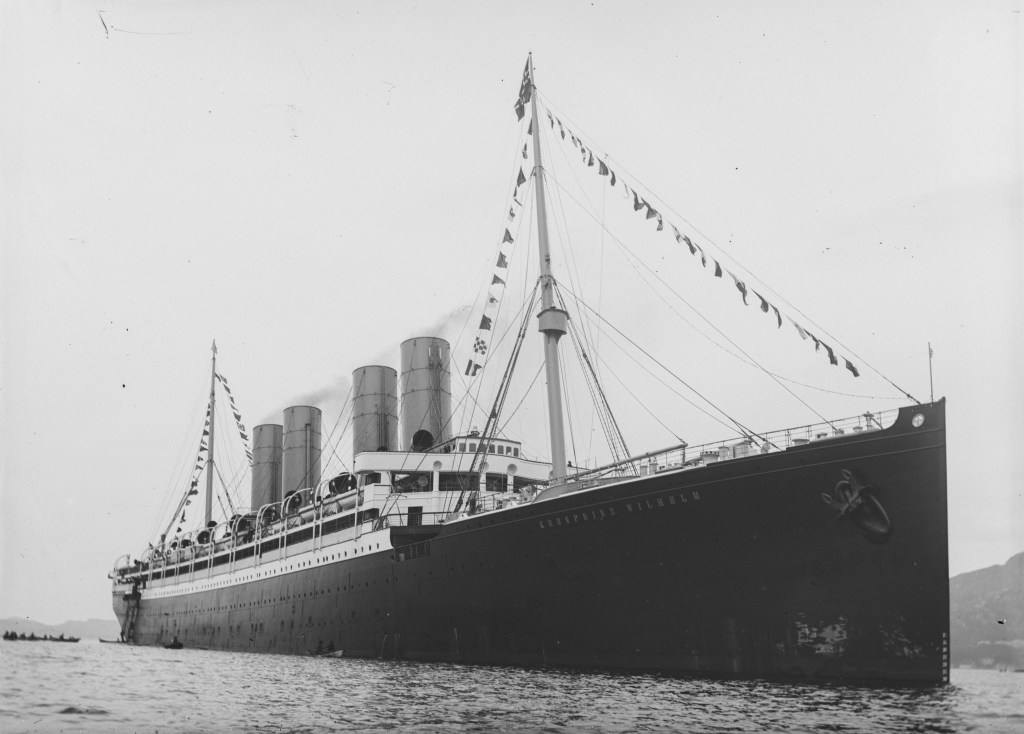
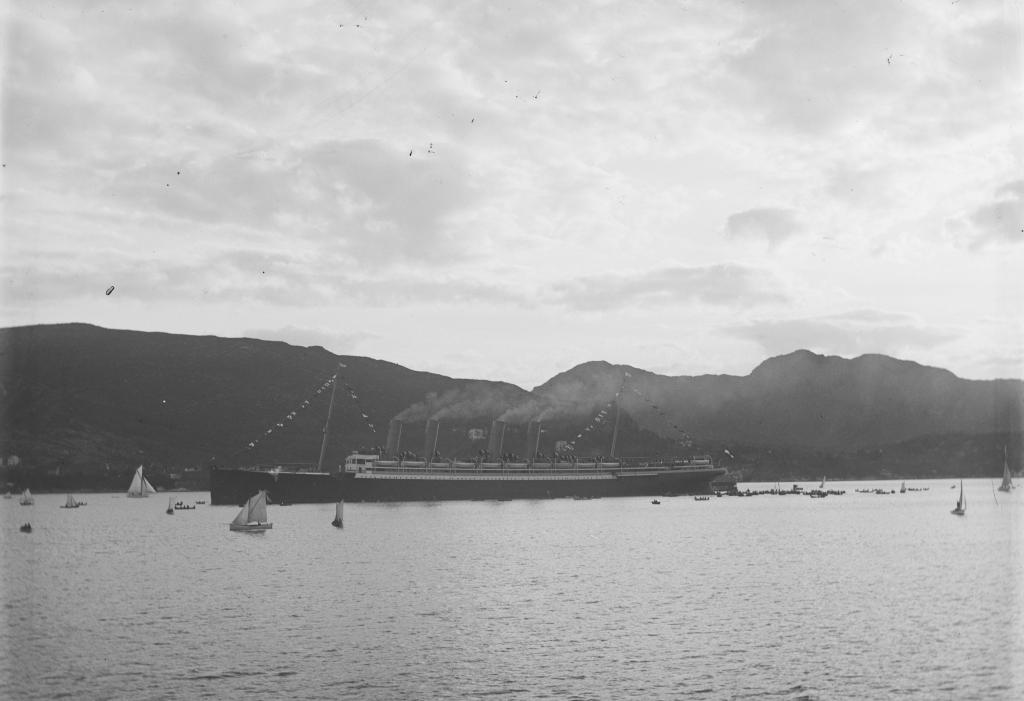

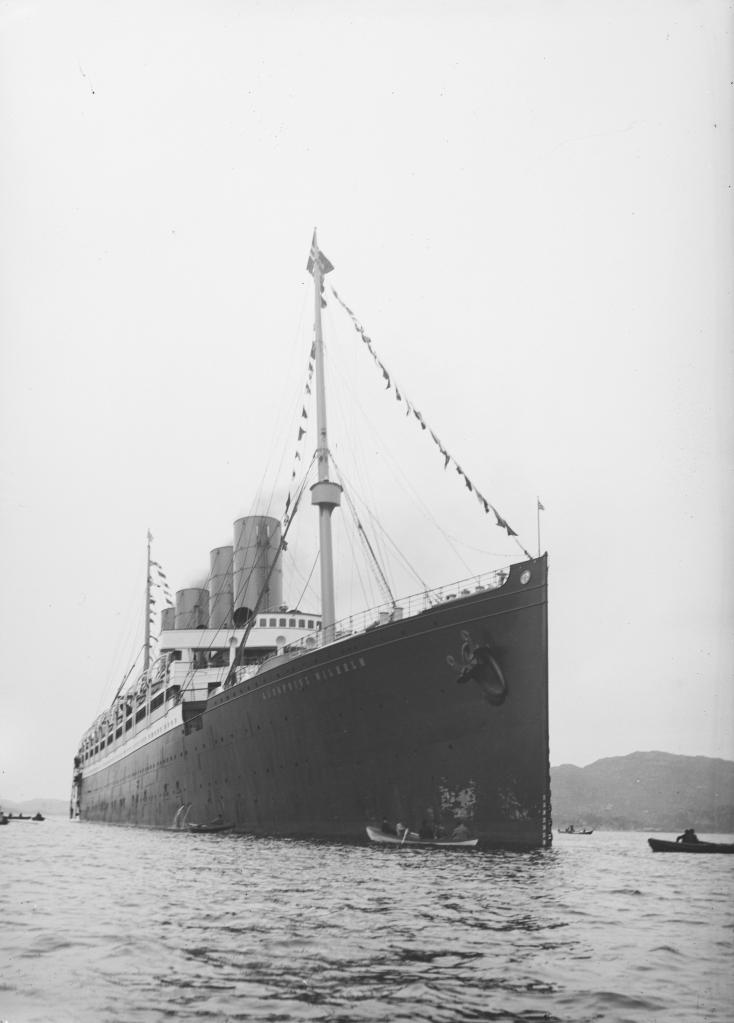
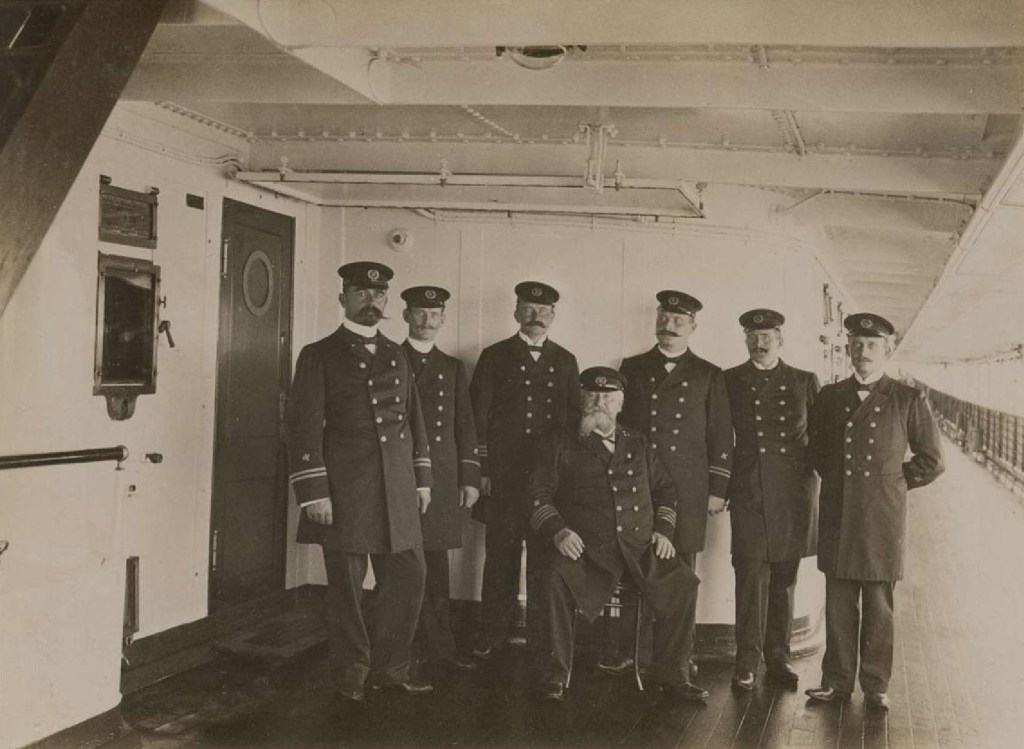
The Kronprinz had been built with the same engines as the Deutschland from the same yard again to ensure she could beat her. The quadruple-expansion engines of the Kronprinz only differed from those on the Deutschland by the exception of the high-pressure cylinders on the valve mechanism. These normally ran at 80rpm, and with all her features the Kronprinz was almost guaranteed to reach at least 22.5 knots. For this first voyage, the ship was commanded by veteran captain, Bernhard Ludwig Störmer. The ship was carrying a party of German business executives onboard too. As the ship sailed through the Baltic, her engine power was increased to 27’000 horsepower and she sailed at 3/4 her max speed. In terms of the results: Lloyd, her engineers, and the Vulkan shipyard were all delighted when the Kronprinz sailed at an excellent average speed of 23.34 knots without even being pushed to her limit. Just like the Kaiser Wilhelm der Grosse before her, the Kronprinz‘s sea trials went very favourably and quickly corrected the mistakes of the Kaiser Friedrich who sadly could barely attain 20 knots during hers.
Satisfied with the performance of their new flagship, there were high hopes of the Kronprinz breaking the record the Deutschland had set soon. She next sailed to the Firth of Forth in Scotland, before docking in Leith on the 10th September. Whilst here many British businessmen, travel agents and other guests were entertained on board. Once everything was done, she sailed back home for her maiden voyage to begin in Bremerhaven, on Tuesday, the 17th September.
The Maiden Voyage
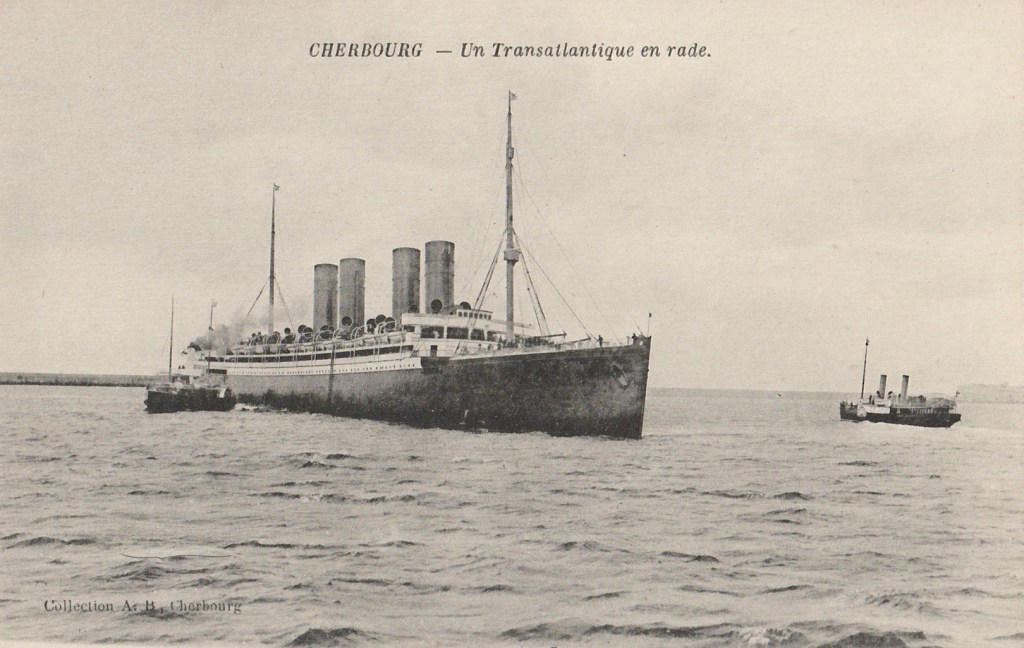
The maiden voyage of the Kronprinz Wilhelm was the exact same route of the two previous express liners before her. She had calls in Bremerhaven, Southampton and Cherbourg before the big stretch to New York. By the 18th September on Wednesday, she had reached Cherbourg with no issues. Mail, passengers and cargo came aboard from the tenders and she departed the coastal town at 8pm this day. A special event happened during the voyage: namely a memorial service for President William McKinley who had passed away on September 14th after an assassination attempt, 3 days before the maiden voyage of the Kronprinz. Rev. George C. Houghton and the president of the Mutual Life Insurance Company: Richard A. McCurdy officiated the memorial. A copy of the resolutions expressing sympathy for McKinley was sent to his late wife: Ida McKinley.
The sombre mood of the voyage so far slowly began to spoil the moment the ship started crossing the open sea. The clear skies quickly became overcast, then steadily grew until the next morning they had developed into a massive gale. The seas grew rough too and disappointingly, the ship had to reduce speed, slimming their chances of a first record-crossing. By Friday the 20th, 2 days out of Cherbourg, the seas were intense and massive waves struck the ship. They kept going steadily despite the fact that Captain Störmer said the waves would “hide the horizon“. Störmer was on the bridge near-continuously during these times. It was today, Friday that an unexpected disaster would occur.
The Big Wave
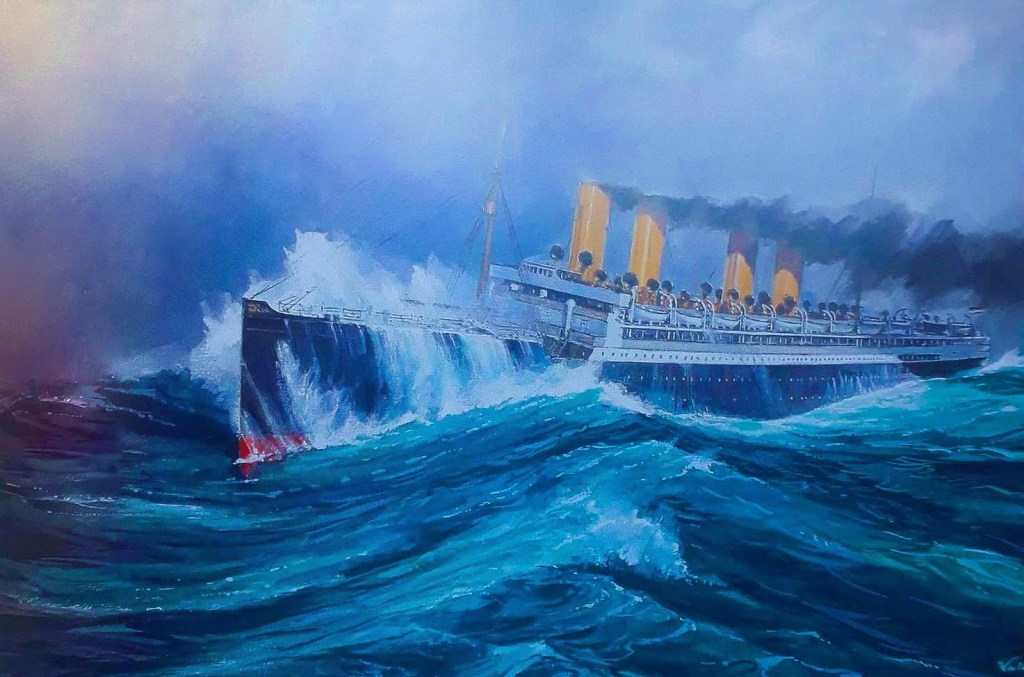
Late at night, at 5am on the 20th September, a massive wave loomed over the Kronprinz, about to collide head-on. Nobody was prepared and this monster easily crashed over the bow. It raced forwards smashing into the forecastle of the ship, crushing the companionway, and tearing two ventilators and the railing off and washing them away. Located right at the base of the forecastle was the magnificent First Class Library, and the wave struck the wall head on, broke two of the three windows and flooded the room. The wave was so massive it could actually strike those in the wheelhouse at the top of the ship, and it did – breaking a window and washing Captain Störmer back, as he clung to the railing on the bridge wing. As soon as it had appeared, the wave vanished and those on board were left to assess the damage.
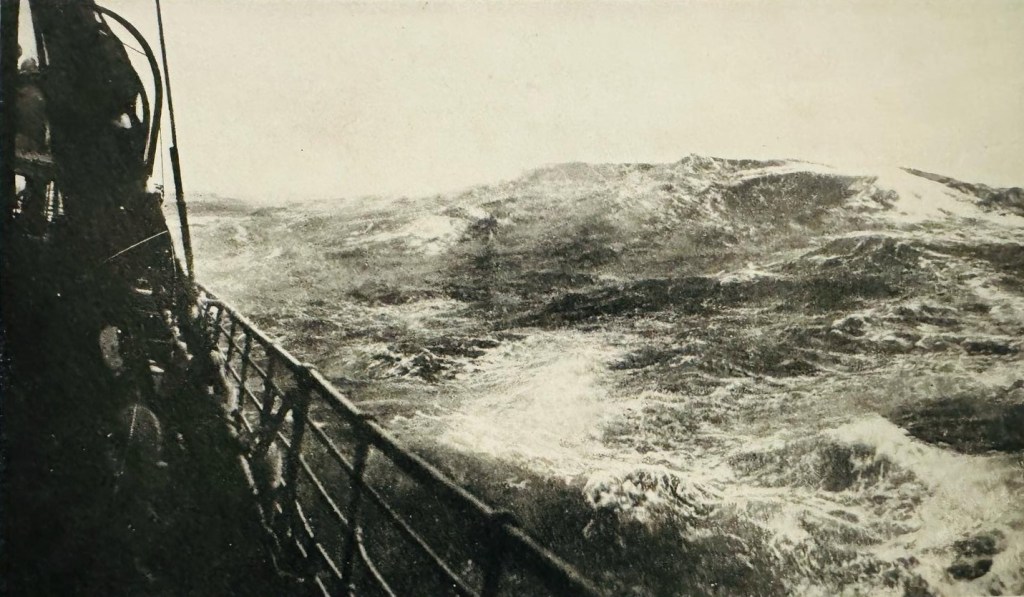
Thankfully nobody was hurt, bar the Kronprinz. All the passengers had been asleep and many did not even feel a thing during the impact. Being so late, the only ones on deck were the bridge crew and Captain Störmer whilst the rest were indoors away from the action. The Kronprinz kept steaming, at around half speed of about 65 revolutions per minute. By Sunday the 22nd, the weather had finally begun to lighten again, and so the Kronprinz to speed up. Despite the gale, she began to make pretty good time, steaming at an average speed of 19.7 knots this day, 23.5 knots the next and 23.96 knots the day after that on the 24th. With all the delays, this maiden voyage was certainly not a record breaker, but the Kronprinz was proving excellent worth with these 23-knot speeds. Captain Störmer was proud of his ship too, being certain she could be a record breaker when conditions were better. The Kronprinz’s outstanding 575 knots covered on the 24th was remarked by the chief engineer as: “The best day’s run ever made on an initial maiden voyage.” The passengers also spoke very positively of their time aboard the ship, saying she was a: “flier of the first class” during better weather. The log of speed during the whole voyage was as follows:
| Day | 18th September | 19th September | 20th September | 21st September | 22nd September | 23rd September | 24th September |
| Knots | 359 | 375 | 383 | 473 | 564 | 575 | 316 |
| Average Speed | 14.96 | 15.63 | 15.96 | 19.71 | 23.5 | 23.96 | 13.16 |
Arrival in New York
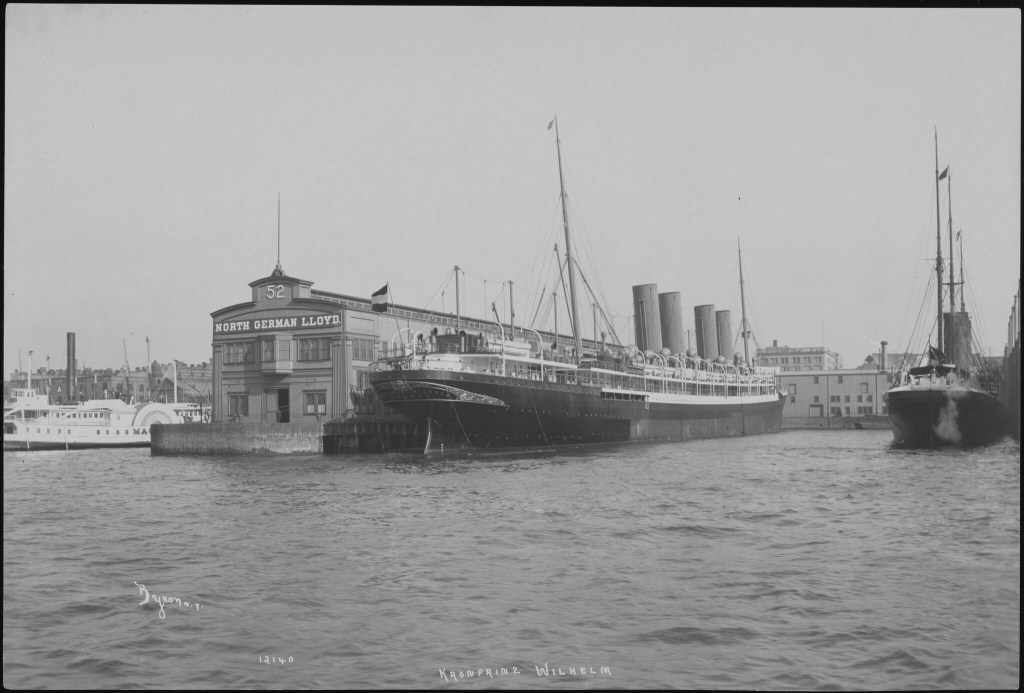
On the 25th September 1901, the Kronprinz Wilhelm finally pulled into New York for the first time. The time elapsed between Cherbourg and New York was 6 days 10 and 15 minutes due to weather delays. For comparison, the westbound record of the Deutschland was 5 days, 12 hours and 16 minutes, at an average speed of 23.09 knots. As shown above, on the days the Kronprinz was not battered by weather, she could absolutely match the 23 knots of Deutschland so on further voyages a record crossing was very much within Lloyd’s reach. Public opinion on the liner was very favourable too, many were impressed by the ship’s resistance and speed despite the odds, no doubt thanks to her highly-detailed construction. The ship had carried several people of note on this voyage too, Vicomte de Benghen (Belgian Minister to Mexico) and Bleste Gana (Chilean Minister to France) just to name a few.
The only thing that mattered to those involved with the ship was her performance after their experience with the Kaiser Friedrich. Fortunately Director of the NDL: G. B. Brauer and Chief Inspector Beul regarded their new flagship as being: “satisfactory in every regard”. Director Flohr of the Vulkan and their engineers (who coincidentally included Störmer’s son) who built the liner also expressed their satisfaction with the completed product. Flohr stated:
“The Kronprinz”, was brought over with Westphalian and English coal. When she goes back we will use American coal, and I expect her to do a great deal better. I should not be surprised if the vessel eventually made a record nearly as great as the “Deutschland”
And he would be absolutely right that this was not representative of the Kronprinz’s potential. She soon took her maiden westbound crossing back to Europe from New York to Bremerhaven. When she landed in Plymouth, she had only taken 5 days, 9 hours and 48 minutes – an average speed of 23.01 knots. Deutschland still held the westbound record at 23.51 knots but she wasn’t nearly that fast on her maiden voyage. The Deutschland’s maiden voyage westbound had been 22.84 knots. That meant the Kronprinz had reached the fastest any ship had ever sailed on their maiden voyage in history. A record crossing seemed inevitable, the only question was time and luck.

Bibliography
- (1901) KRONPRINZ WILHELM HAD A STORMY VOYAGE, New York Times, 26th September.
- Schünemann, Carl (1901) Die Geschichte und die Entwickelung des Norddeutschen Lloyd
- Sander, Styllz (2020) The World of German Liners: https://www.worldofgermanliners.com/kronprinz-wilhelm (Accessed: March 2025)
- Schrödter E. & Beumer W.(1901) Stahl und Eisen Nr. 19, 1st October, p. 1019 – 1021.
- Journal of the American Society of Naval Engineers, inc v.13 1901 https://babel.hathitrust.org/cgi/pt?id=uva.x002209403&seq=1396&q1=kronprinz
- W. Smith Eugene (1947) Trans-Atlantic passenger ships, past and present p.19 https://babel.hathitrust.org/cgi/pt?id=mdp.39015006387842&seq=31&q1=kronprinz
- Marine engineering v.6 1901 https://babel.hathitrust.org/cgi/pt?id=mdp.39015075041841&seq=492&q1=kronprinz
- The Iron age v.68 (1901) https://babel.hathitrust.org/cgi/pt?id=uc1.c2623587&seq=508&q1=kronprinz
- Notes
 The Kaiserhafen