
| Name | SS Deutschland |
| Operator | Hamburg Amerika Line |
| Yard Number | 244 |
| Code Number | RLQD |
| Builder | AG Vulkan, Stettin |
| Launch Date | 10th January 1900 |
| Maiden Voyage | 5th July 1900 |
| Tonnage | 16’502 GRT 6’908 NRT |
| Length (LOA) | 208.5 meters |
| Length (LWL) | 201.47 |
| Width | 20.43 meters |
| Draught | 12.28 meters |
| Installed Power | 33’000 hp |
| Maximum Power | 37’800 hp |
| Propulsion | 2 quadruple-expansion steam engines |
| Speed | 22.5 knots service (41.67 km/h) 23.50 knots max (43.52 km/h) |
| Crew | 543 |
| Passengers | 1st Class: 429 2nd Class: 226 3rd Class: 284 Steerage: 1000 |
| Construction Cost | $3 million (1900) 12.5 million marks |
“The Cocktail Shaker”

SS Deutschland was a true ship of the decade. Commencing her maiden voyage in 1900, this vessel very quickly established herself as one of the most significant of the early 20th Century, besting the world’s first superliner SS Kaiser Wilhelm der Grosse, being the only ship in the history of her line to carry the Blue Riband, became one of the world’s first true cruise liners as the SS Victoria Luise, was supposed to be requisitioned in WW1 and finally ended her days as a humble migrant-carrier as one of only two liners left in her country by The Great War’s end. This ship saw and did everything, and proudly remains as one of the five German four-stackers, being the only one who saw proper service after the war whilst the rest were indefinitely mothballed, in varying states of condition.
Conception
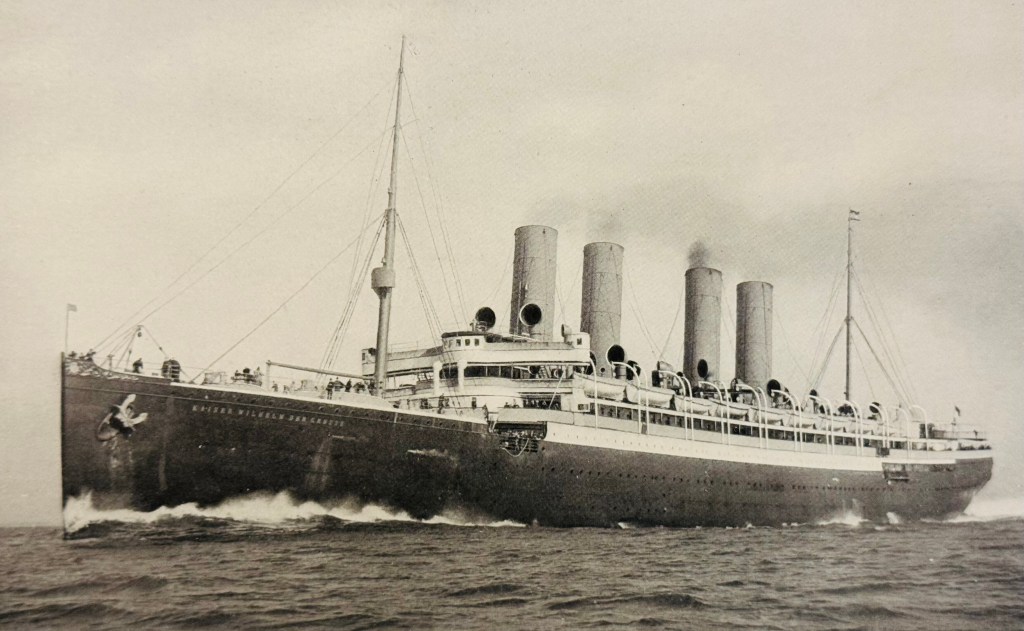
Throughout the 1880’s and 1890’s the Hamburg American Line (HAPAG) was on a real hot streak in terms of moving the company forwards. Since the entry of Albert Ballin within the company and his pushes for double-screw vessels with the resulting Augusta-Victoria class, the company had grown remarkably over the next ten years. The four vessels of the Augusta Victoria class were some of the most highly-technical and prestigious ships in the world, sweeping ahead of their biggest rival: the North German Lloyd Steamship Company. Hapag and Lloyd were by far the two biggest juggernauts of all German shipping companies, and they fought to outdo one another for decades. The Augusta-Victoria class ships were express steamers and provided the fastest mail services in the world, but Ballin grew disinterested in the type after the British steamers: Campania and Lucania came out only a year after the last of the four – Fürst Bismarck in 1892, and completely outclassed them.
He knew how trying to push for the fastest vessels was a never-ending, expensive race with new ships becoming outdated within just a few years, and so he chose to focus on size and luxury, which appealed to the largest clientele possible. Others within Hapag completely disagreed with him, and that was entirely to do with the ship that had now outclassed the Campania and Lucania by 1897: SS Kaiser Wilhelm der Grosse, a ship that had been built by Lloyd. Everyone knew the pure propagandic value and honour this ship held: with it being the largest, fastest and most luxurious liner in the world, Lloyd was completely on top of Hapag and the company had nothing that could match it. This situation was unacceptable to the Hapag board of directors and they ignored Ballin’s idea to build a larger but slightly slower adversary to the Kaiser. They themselves made the bold decision to approach the same yard that had built their rival: AG Vulkan Stettin, and have them build another ship that was superior in every way. This was to be: the SS Deutschland.
Creating the Deutschland
Contract:
In 1898, two ships of the Augusta-Victoria class: Columbia and Normannia were sold to Spain to be used as auxiliary cruisers for very high prices. This money went right into funding their successor, the new ship to be built by the Vulkan shipyard in Stettin. They granted the Vulkan a contract whose specification had only a single sentence: “Build us a ship that surpasses the Lloyd four-funnelled ships in every aspect”. The Vulkan was given full creative freedom, and the ship they chose to design followed their 1897 creation very closely building an enhanced and modified ship, larger and faster than before.
Specifications:
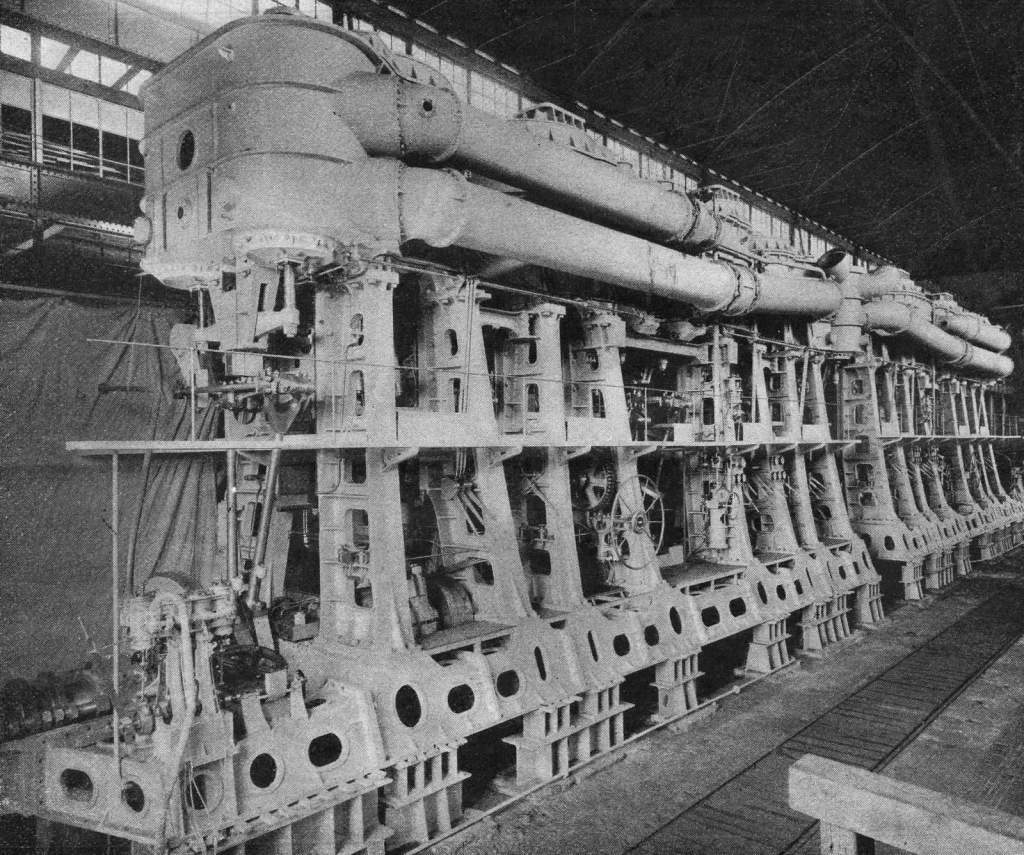
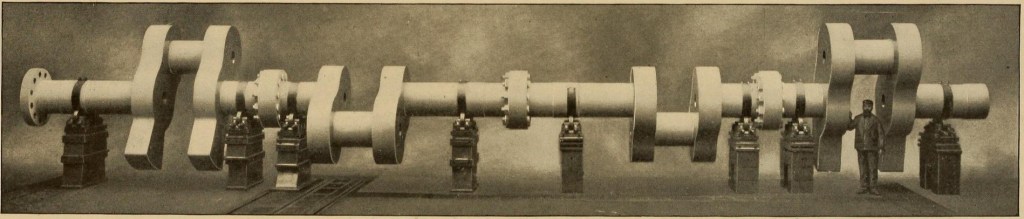
The absolute most important thing the Vulkan knew Hapag was expecting was improved speed, and they gave this criteria immense importance. Compared to Kaiser Wilhelm der Grosse’s triple-expansion steam engines that outputted 27’000 horsepower, the Deutschland would receive the world’s greatest engines: six-cylinder, 4-crank, quadruple-expansion steam engines that could output a ridiculous 33’000 horsepower. The Kaiser had a service speed of roughly 22 knots, so the Deutschland would need 23 knots. Even increasing speed by half a knot required much more power at these numbers, so Deutschland’s engines compensated for any possibility. With these, she could steam 565 miles per day, whilst the Kaiser could only do 502 literally meaning Deutschland could arrive in New York almost a full day earlier.


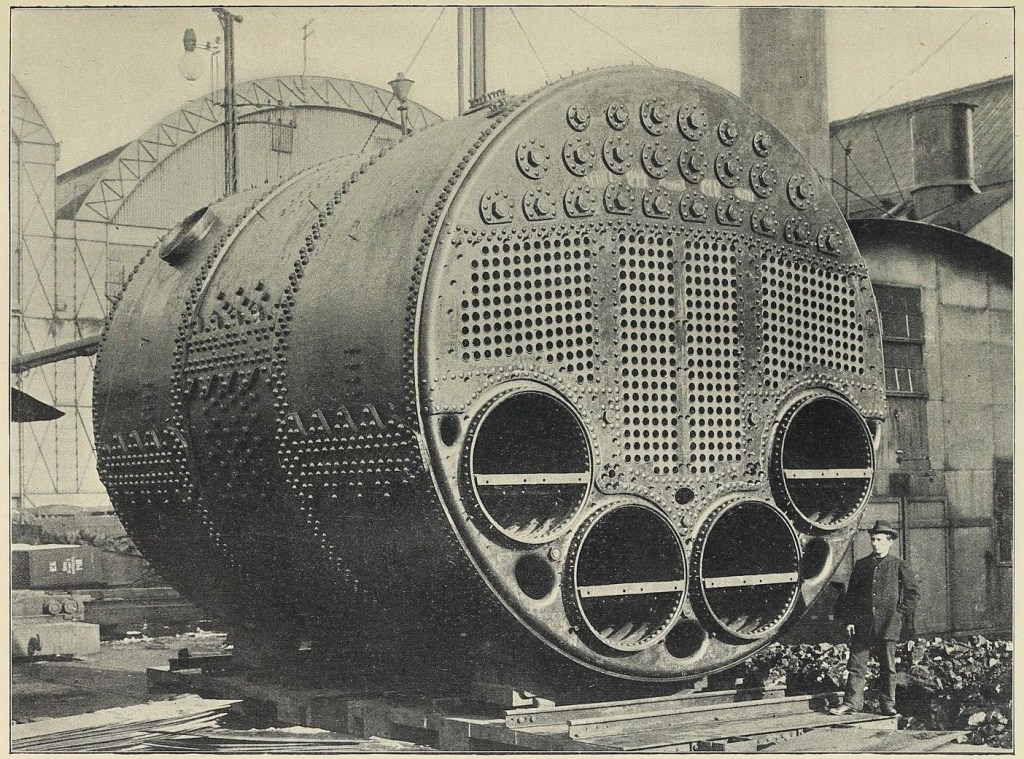
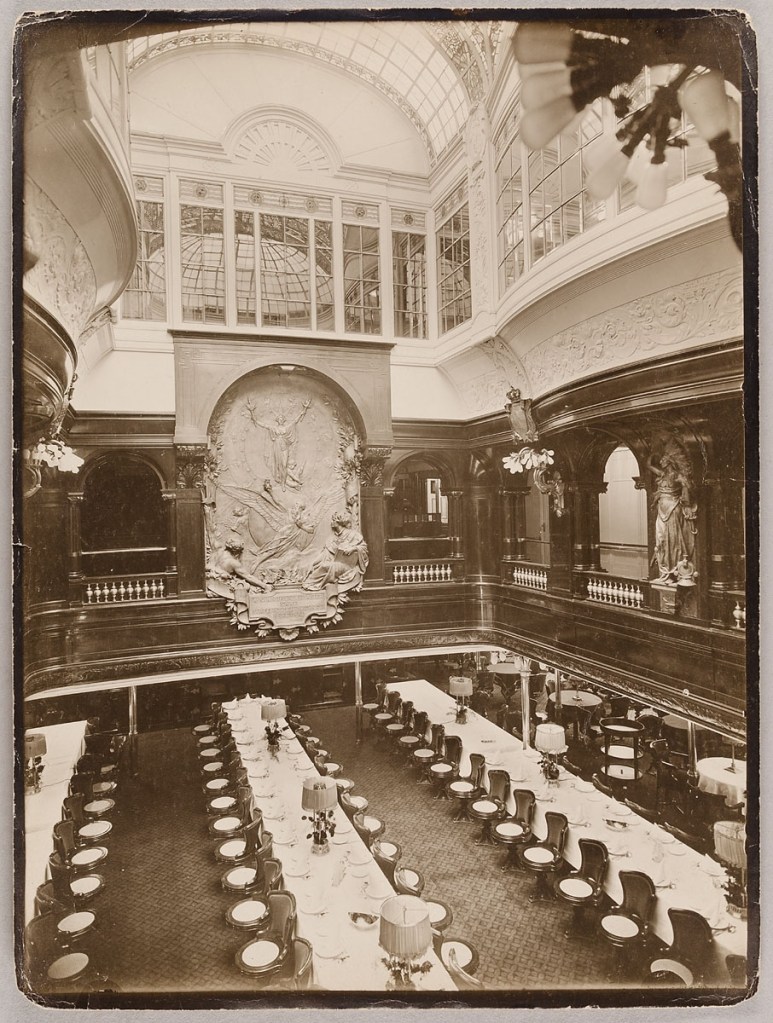
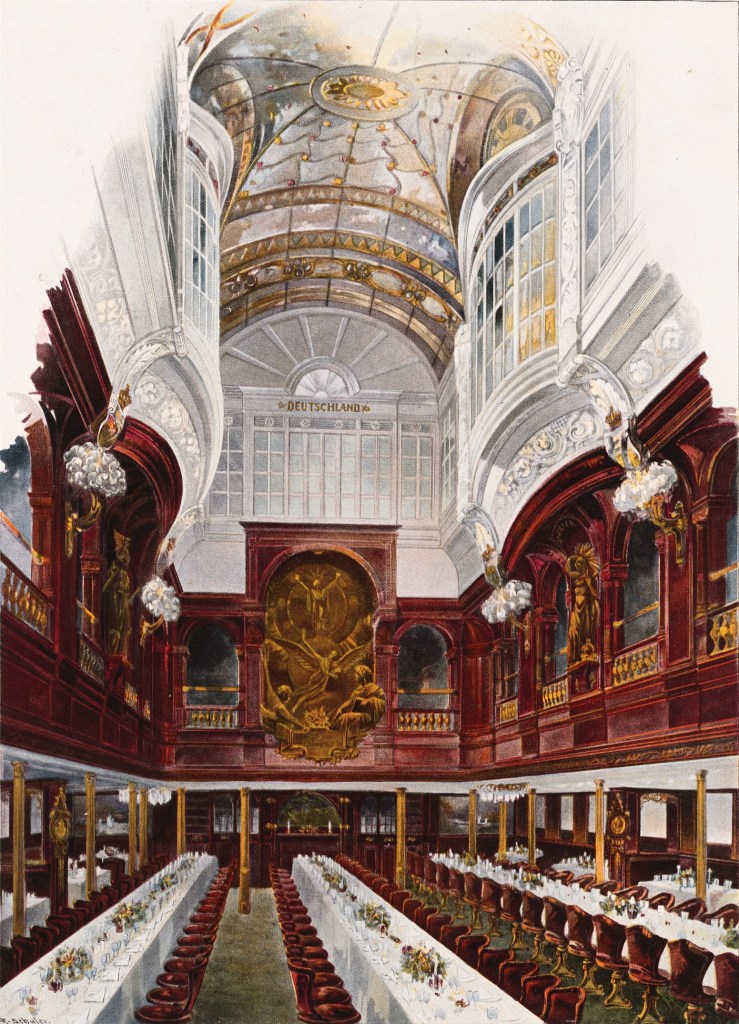
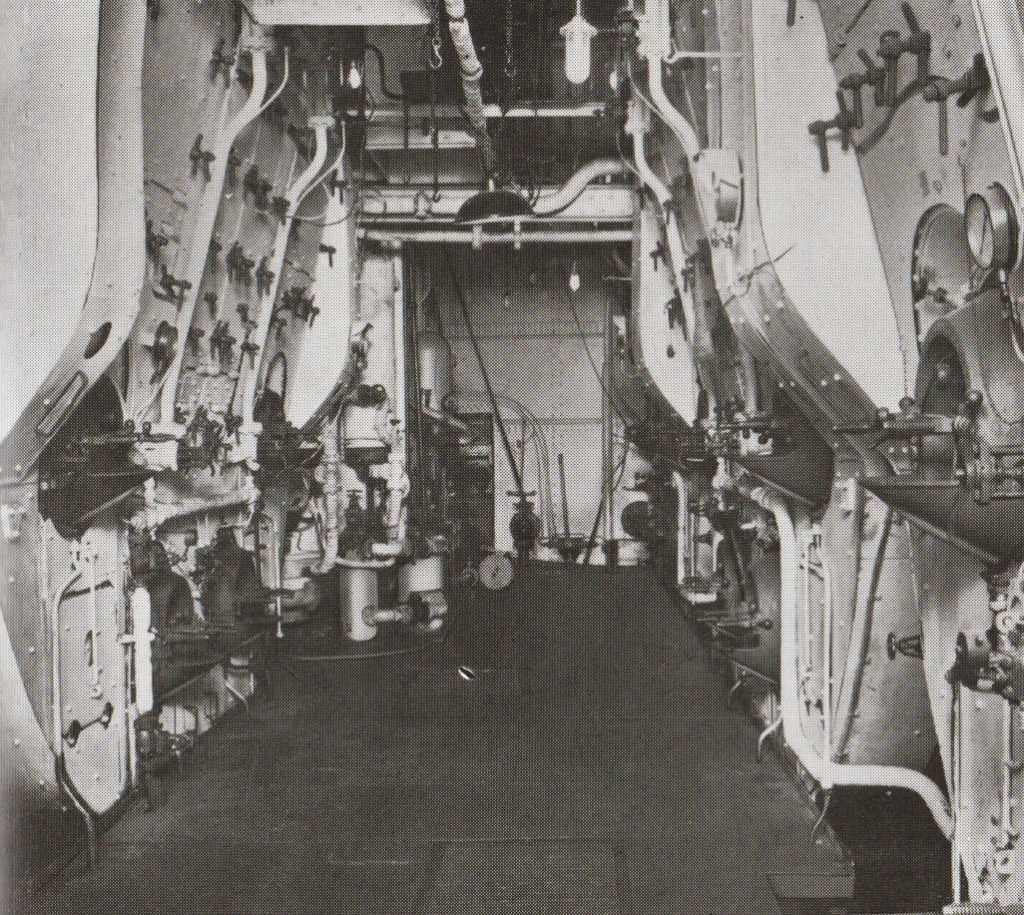
These engines would be supplied by 12 double-ended and 4 single-ended boilers that were arranged in 2 boiler rooms, each room venting through two funnels. When everything was pushed to its limit, the engines outputted 36’000 horsepower whilst the Kaiser’s max was about 30’000. The boilers worked at 220 psi in tow open stokeholds and had a total heating surface of 84’468 sq.ft. Big attention was also given to the interior decoration of the Deutschland. Kaiser Wilhelm der Grosse had been such a trendsetter, her interiors even inspired popular slang at the time so the Deutschland was designed to be even more elaborate and luxurious. She would also be significantly larger, being 16’502 GRT and 684 ft. overall compared to the Kaiser’s 14’349 GRT and 649.5 ft.
Construction:
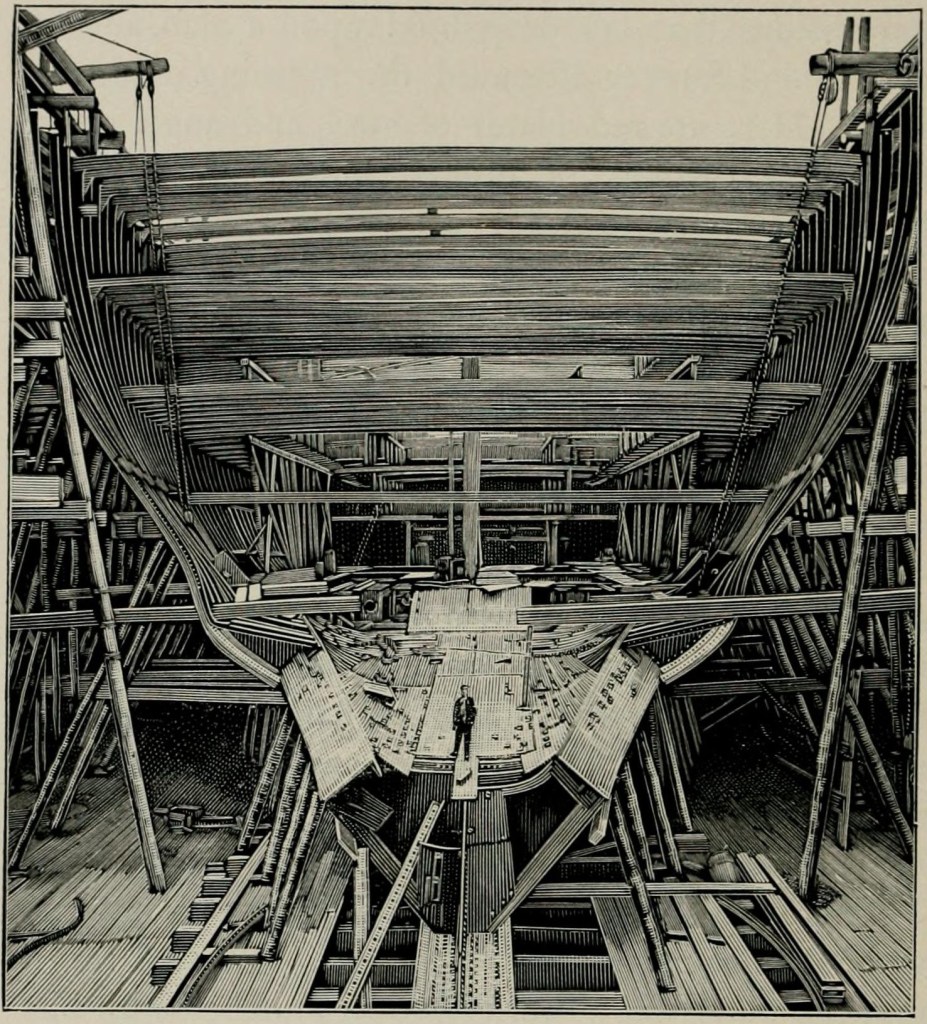
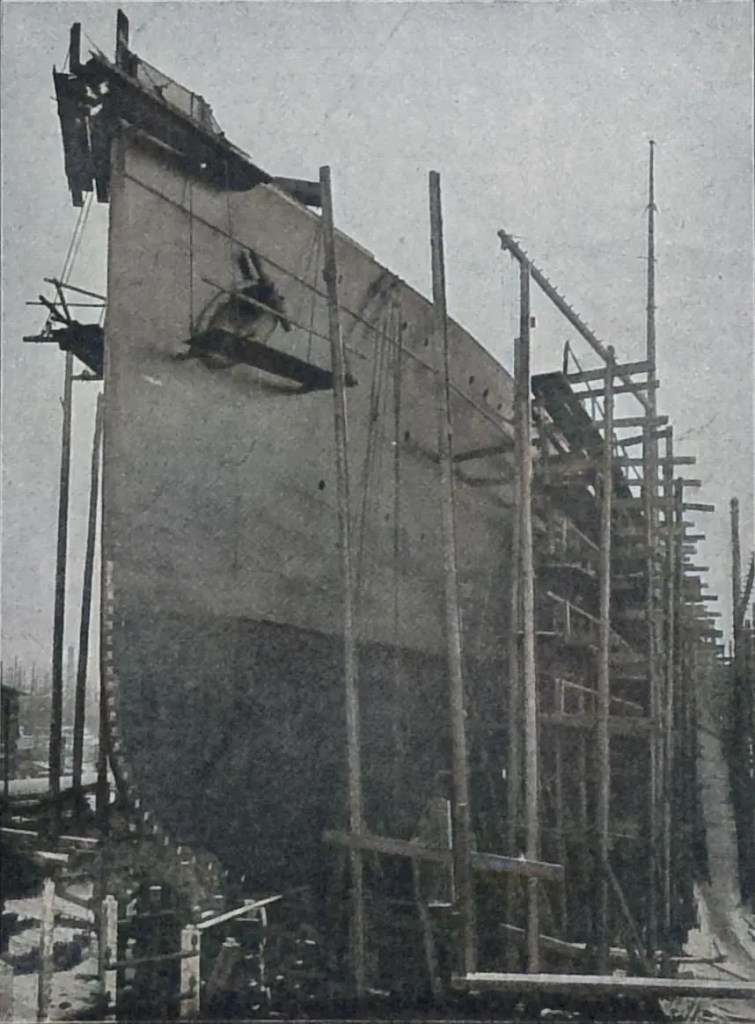
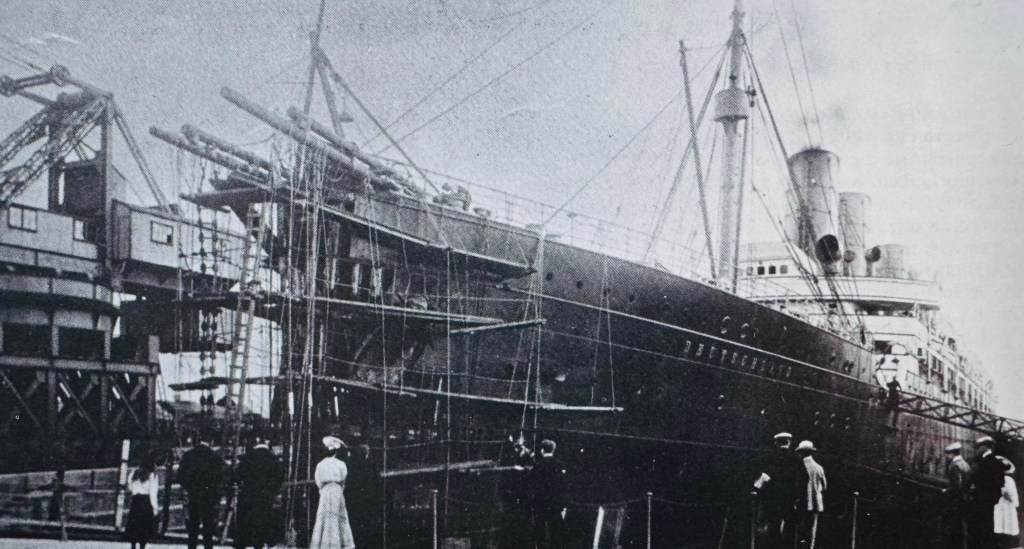
Starting construction in 1899, just two years after the Kaiser Wilhelm der Grosse, the Vulkan shipyard began to build a ship that was to be the second-largest in the world, after White Star Line’s RMS Oceanic who like Ballin, preferred size and luxury over speed. Deutschland was built with every technology to make her as modern, safe and highly-advanced as possible. The forward ribs of the ship, when fastened to the keel, were built especially strong to resist ice and collisions not to mention the force of the water against a ship this fast.
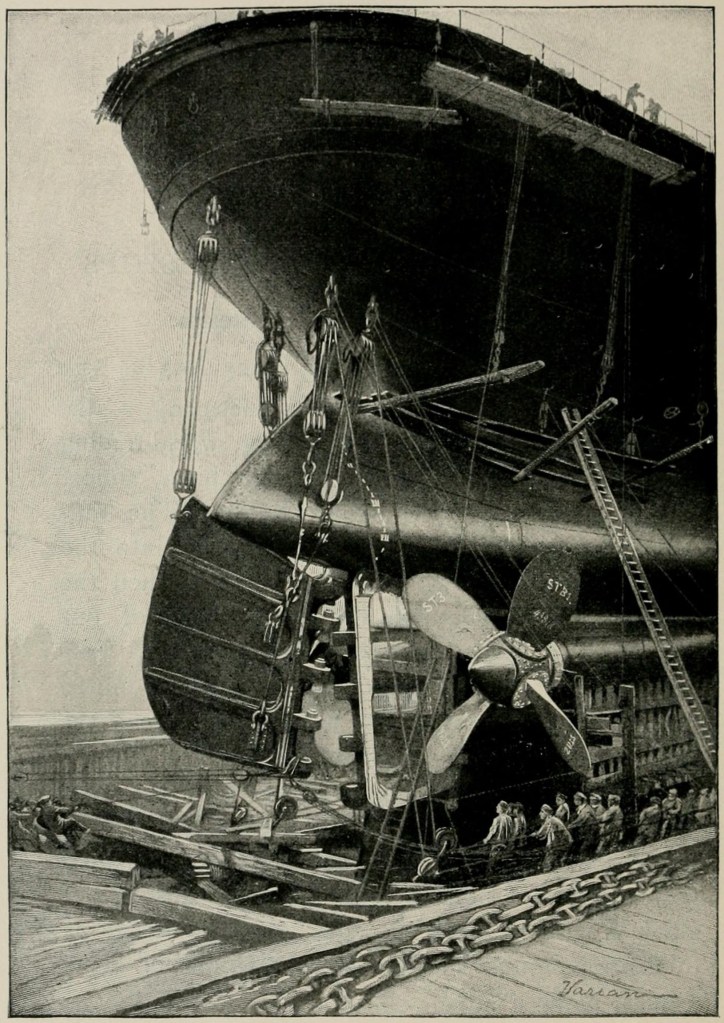
German regulations for the construction included swift conversion for military use: namely the propellors and rudder were reinforced to withstand artillery, gun mounts were placed on the decks, and guns were stored ready at Hamburg and Kiel, to allow the ship to be requisitioned and converted for war in only a fortnight. American regulations also applied when building this ship, she was given hand fire pumps and a drifting anchor to literally allow the ship to be still be steerable if she lost both propellors and rudder.
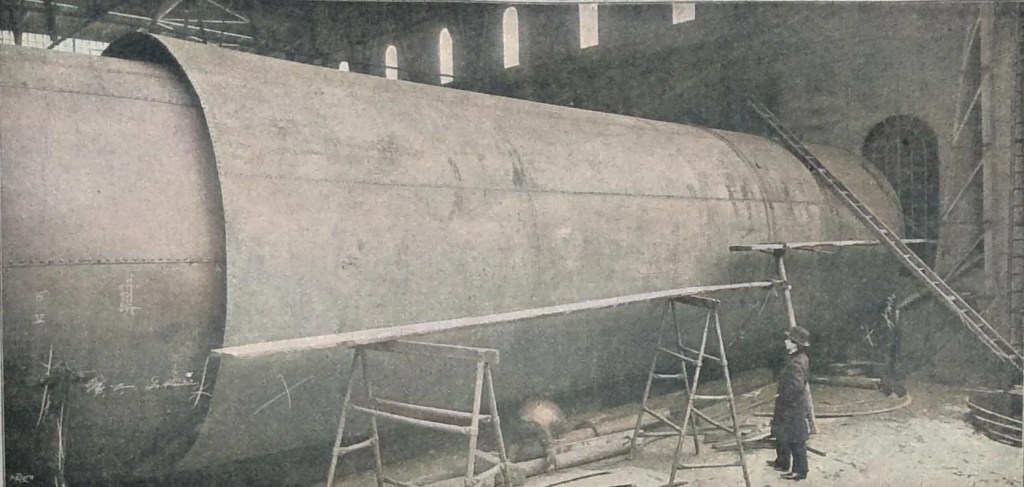
Different stages of the Deutschland during construction at the Vulkan Shipyard, Szczecin.



The Launch
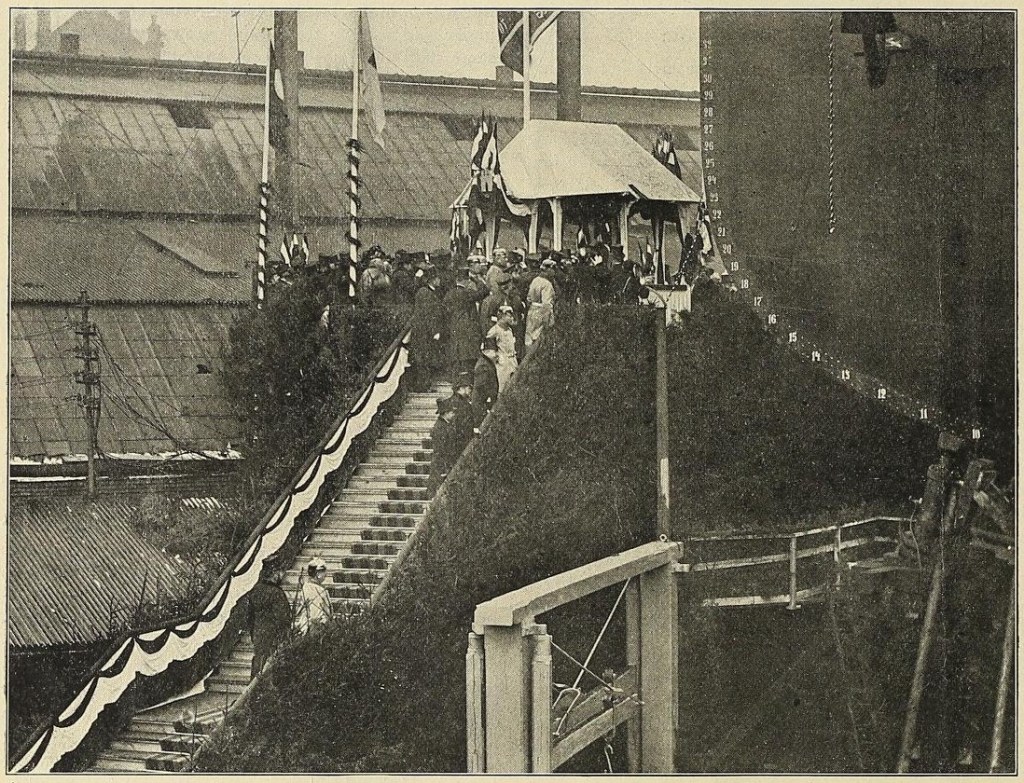
In total, six months had been spent designing Deutschland and it took 1500 men two years to make that ship a reality. By January 1900, she was ready to hit the water. It was this same month Kaiser Wilhelm II himself came to the shipyard once again with his consort, to christen and launch the ship. Three years prior he had been here previously to launch the Kaiser Wilhelm der Grosse, and both of these events were special because he rarely left the capital city for anything. He had arrived with an incredibly prestigious consort aboard the government yachts that included Admiral von Tirpitz, Baron von Rheinbaden, Count von Bülow and many other prominent ministers. Despite the foggy weather, the launch would go smoothly to the delight of the thousands watching. Count von Bülow was the one who pulled the cord, sending another bottle of champagne crashing into the stern of the ship, and Deutschland slid into the waters for the first time Before that, he gave a mighty speech:
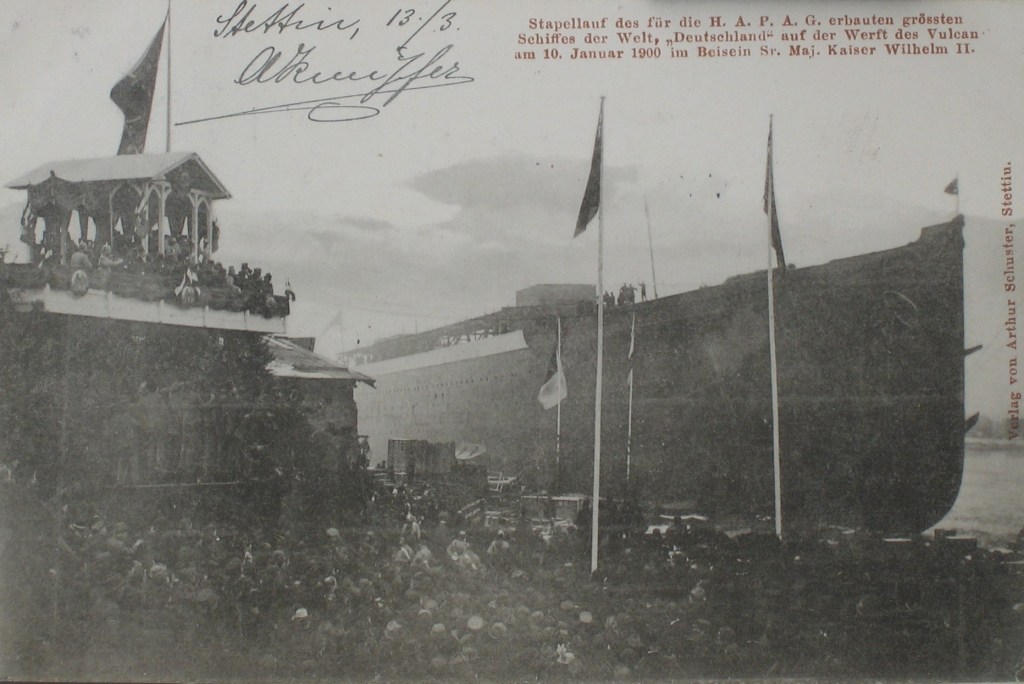
“If we have to overcome obstacles on the path marked out for us by destiny, to pass over difficult places, this will neither disconcert nor discourage us. Courageously, steadily, and energetically we must and will advance toward our goal. The name this ship is to receive is the name of the first ship of the Hamburg-American Line, a small sailing vessel, which put to sea in 1848, from Hamburg to New York, with 220 passengers, that name which is the dearest, most sublime, and most sacred-Deutschland. I christen thee with the name of Deutschland.”
“God bless and protect this ship. Protect the friendship and commerce between us and the United States.”
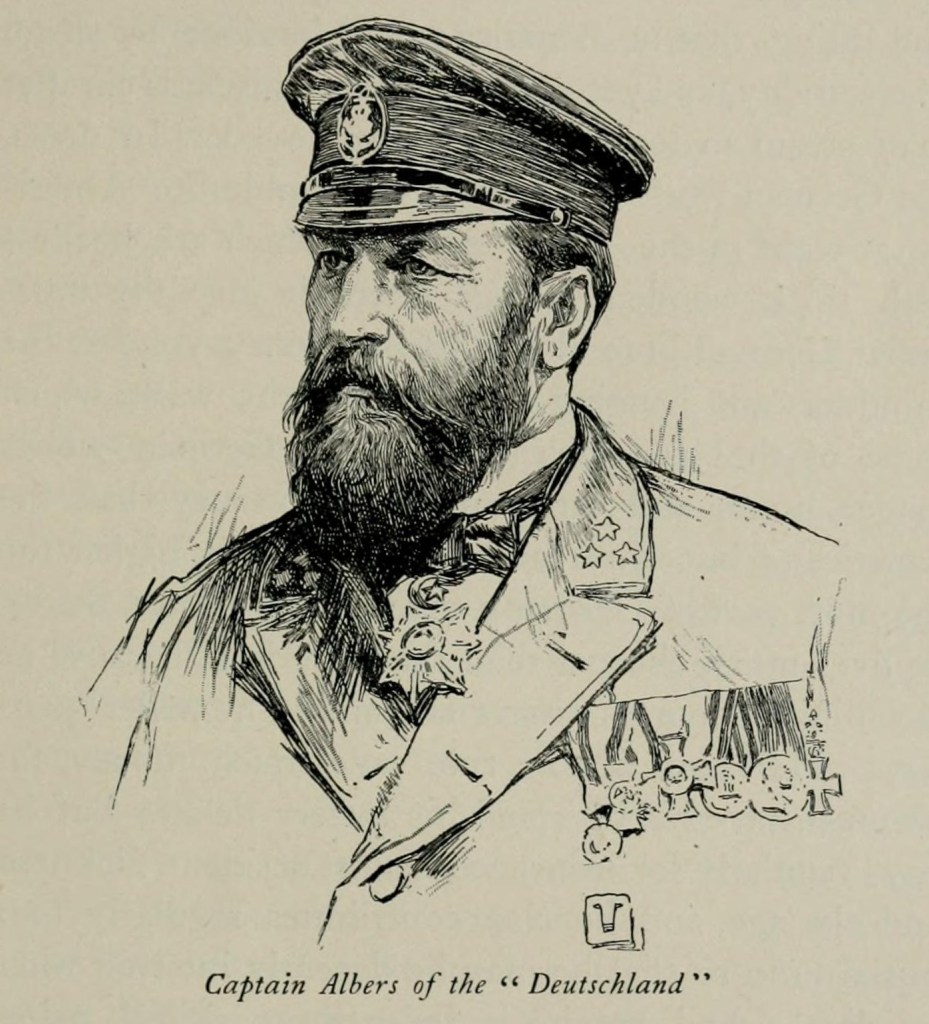
There was still much work to be done, as the ship was just an empty hull. She required her engines, machinery and luxurious fittings which when added would bring the final cost up to $3’000’000. For a comparison, the Kaiser Wilhelm der Grosse had costed $2’700’000 and the additions to Deutschland were worth every penny. She would sail to New York on the 4th July 1900 under Captain Albers, and finally dethrone Lloyd as the number-one German shipping line.
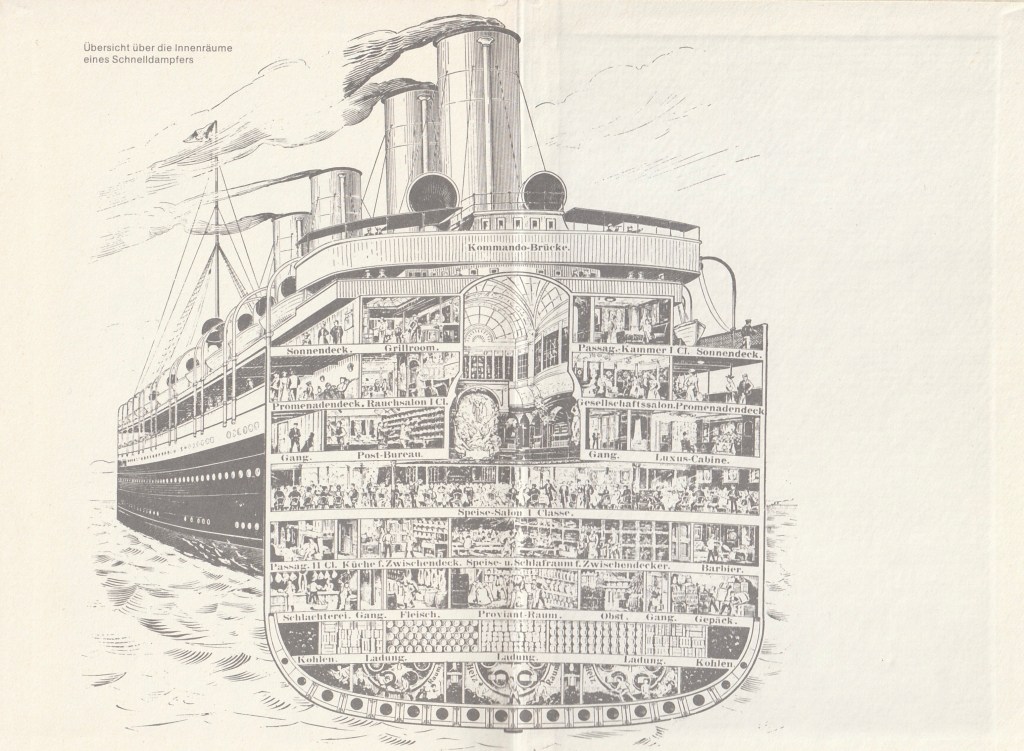
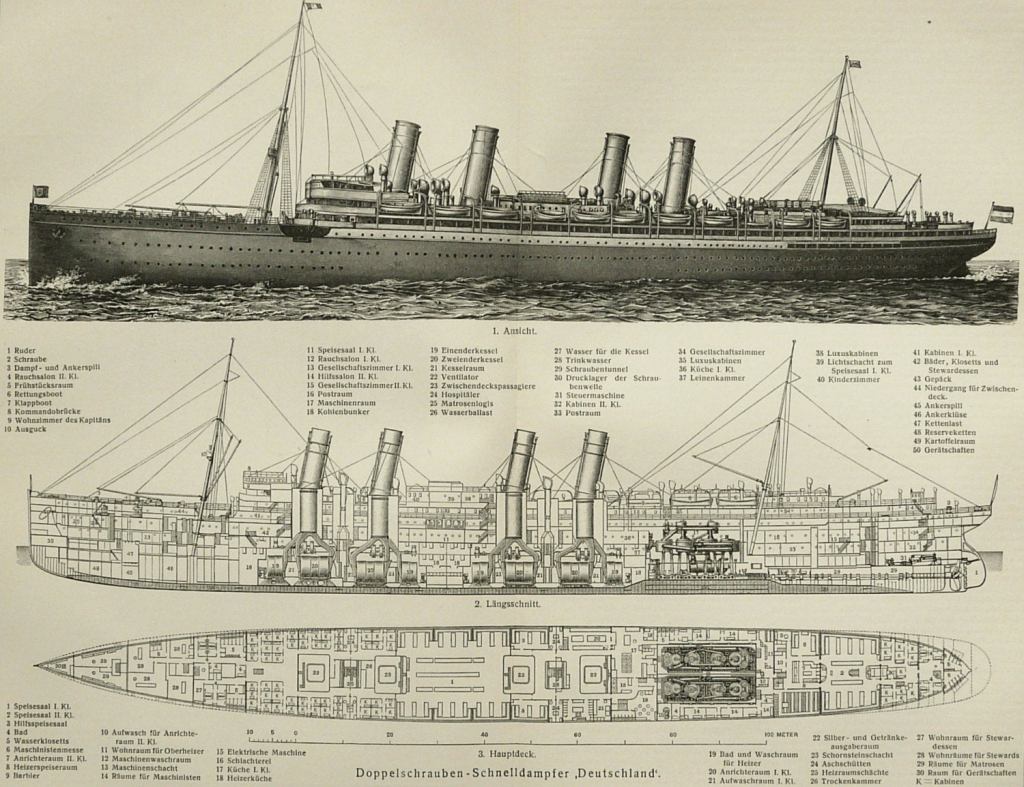
Deck Plans and Cutaway

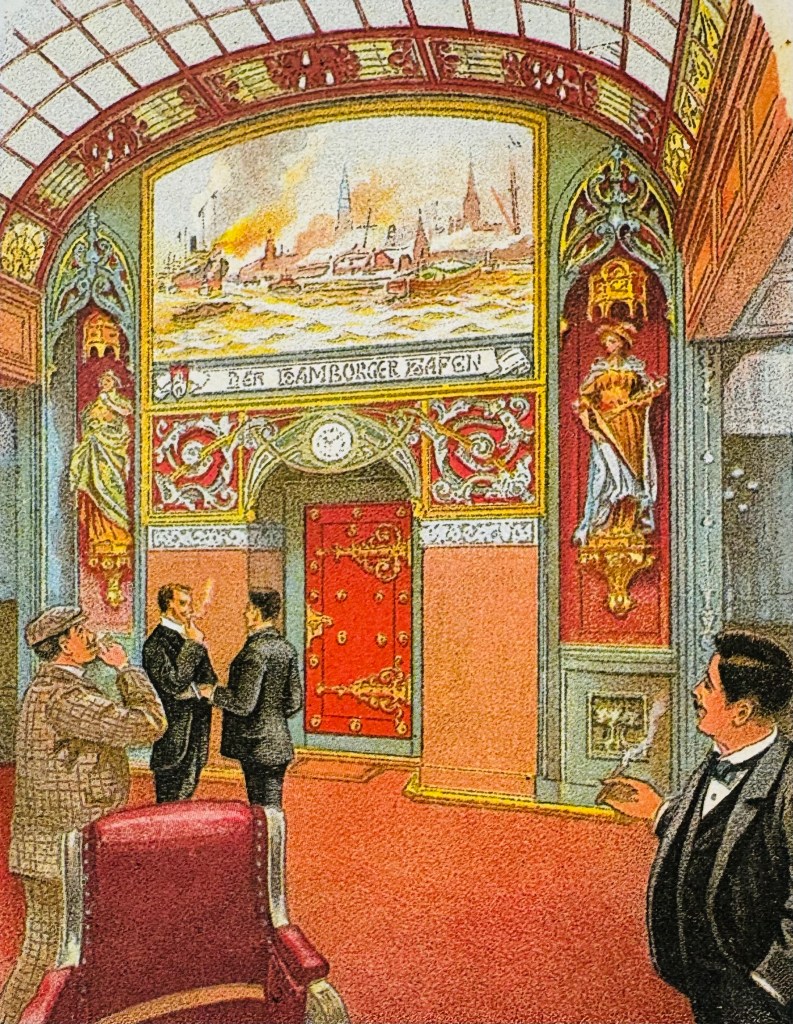
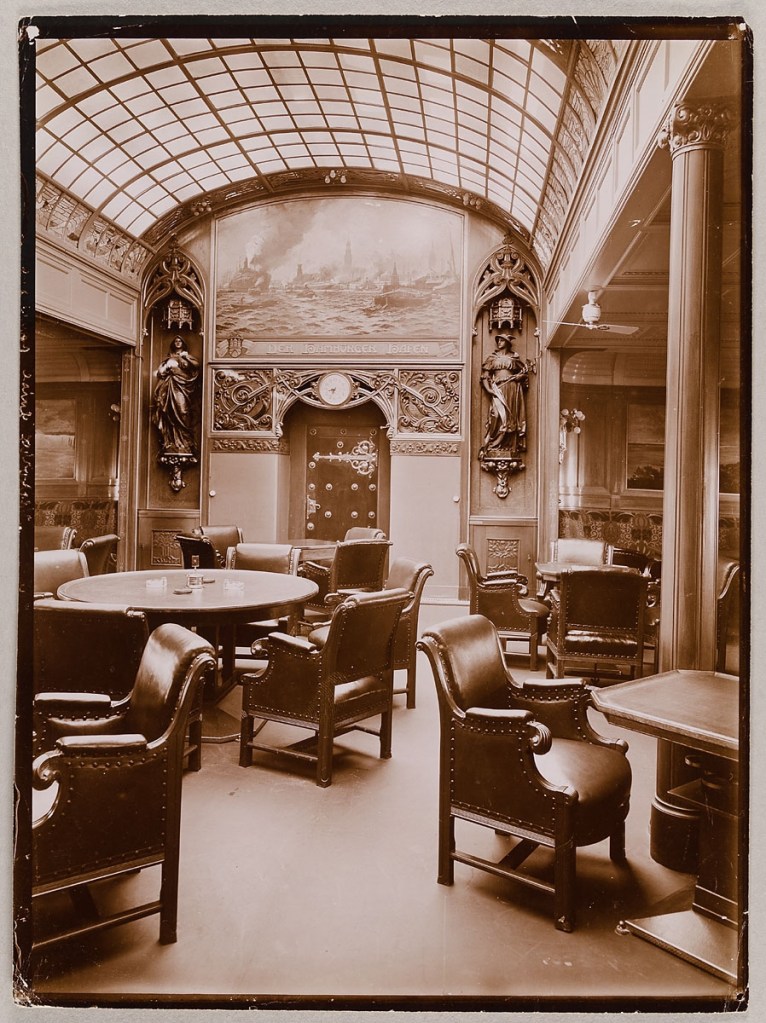
Interiors
Coming Soon!


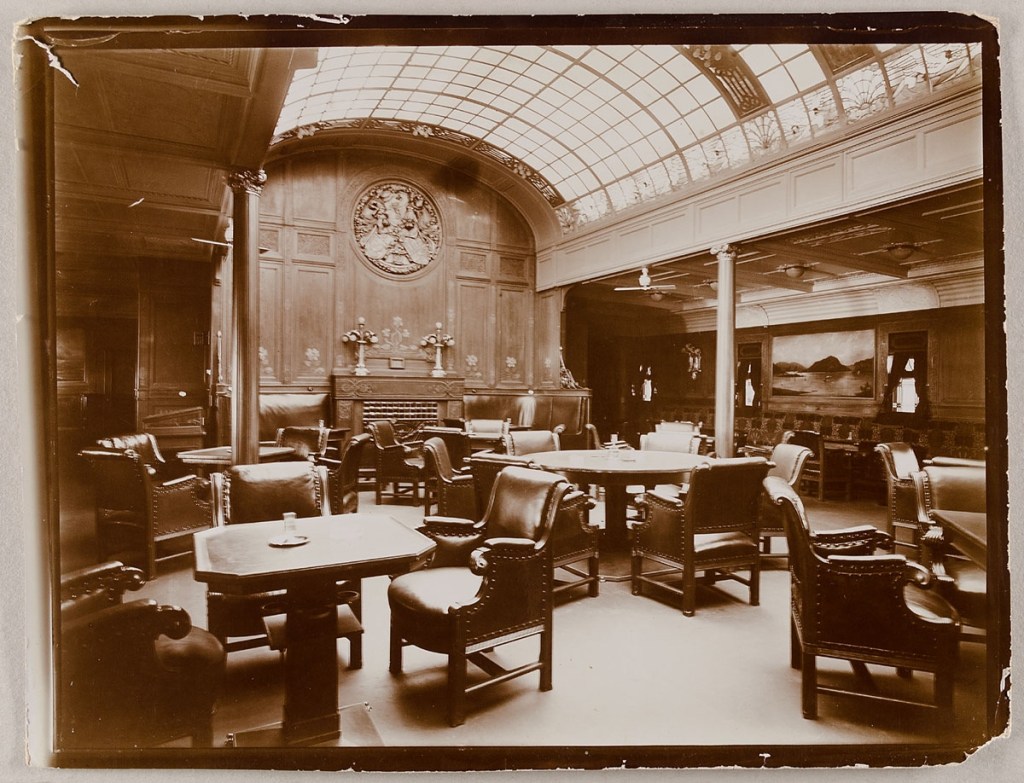
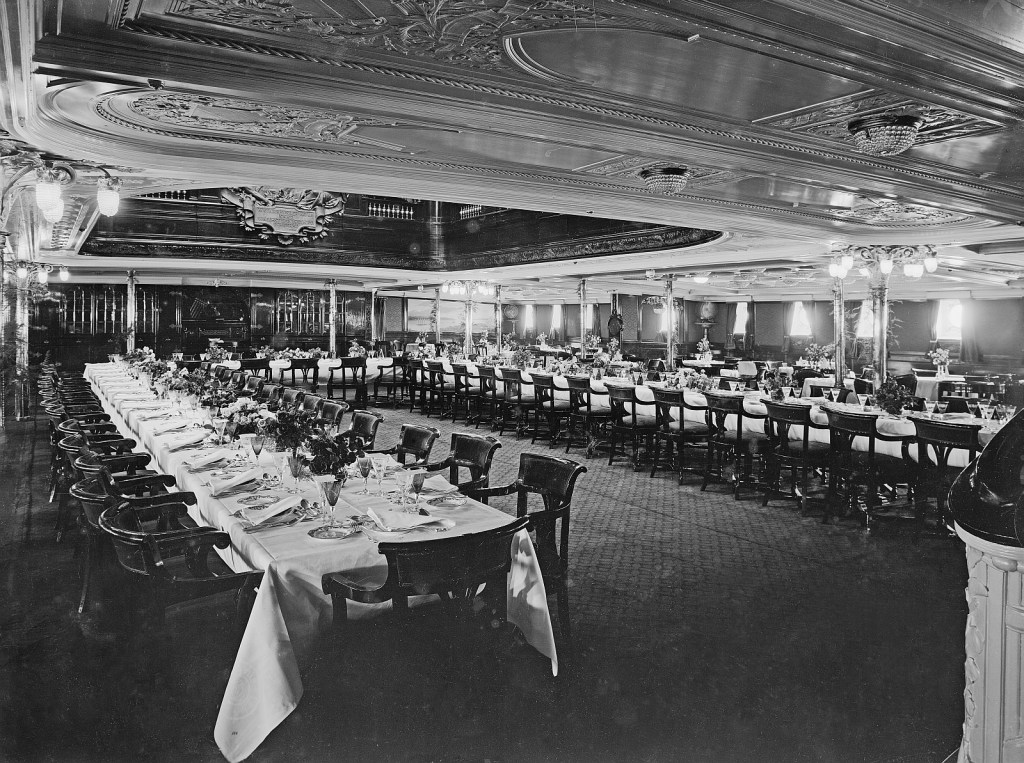

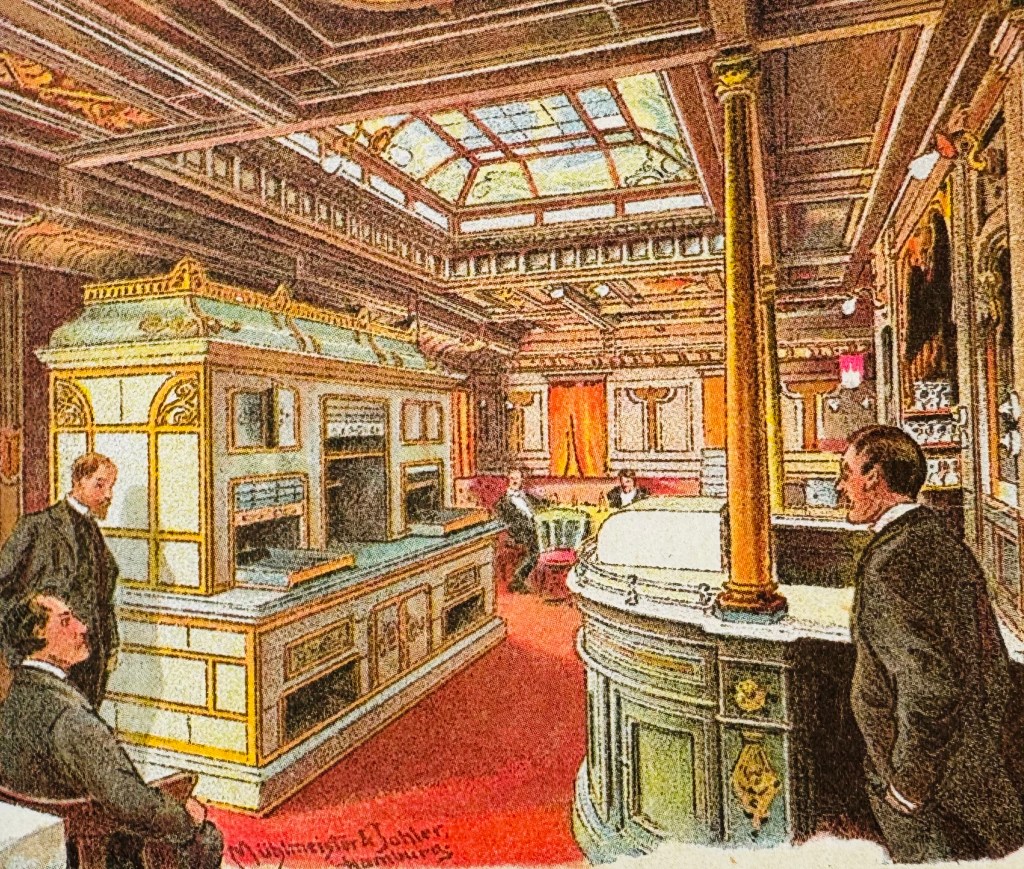

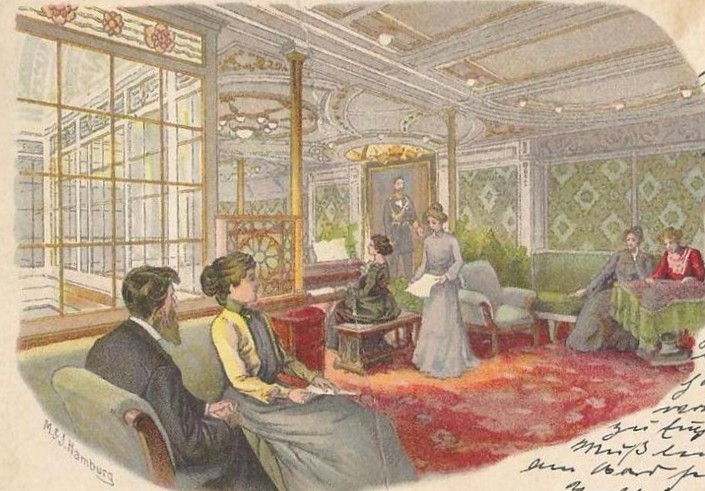
Taking the Blue Riband
Pre-Maiden Voyage mishap
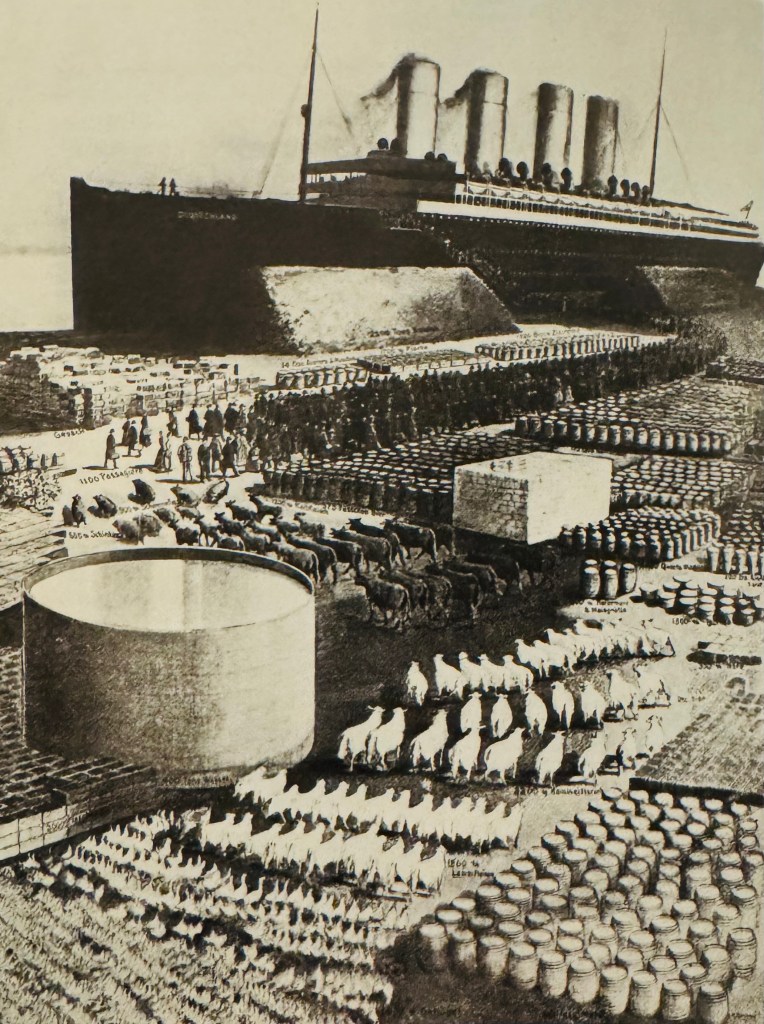
The time seemed right for the Deutschland to set forth and overtake Lloyd again. The sea trials had gone well with very promising results and Hapag themselves were already happy when 2 years previously, the SS Kaiser Friedrich: the running mate to the Kaiser Wilhelm der Grosse had severely underperformed, and given Hapag a full year to leap ahead as a replacement liner would not come until 1901. In late June 1900, Deutschland proudly left the Vulkan shipyard in Stettin with seven tugs fully completed under much cheer to await her maiden voyage on July 4th. Things did not start out promising as whilst making her way down the river Oder towards Swinemunde, she ran aground on a bank and got completely stuck. An immense operation to free her commenced involving all seven tugs, the salvage vessel Seeadler and even two warships, all of which failed to free her. Those associated were extremely worried that a shoal might form around the ship and damage her as Deutschland was trapped for a fortnight. Finally the day before her maiden voyage she was dislodged with the help of dredgers and was thankfully found to be completely undamaged.
First Crossings
It was finally time, and Hapag had very nearly missed their mark. SS Deutschland set forth on her maiden voyage on the 4th July 1900 from Hamburg with her final destination of New York under command of Captain Albers. By the 6th she had already cleared both Plymouth and Southampton and now headed for the big stretch across the Atlantic for the Blue Riband. She arrived in New York in just 5 days, 14 hours and 46 minutes at an average speed of 22.42 knots, a full 4 hours and 14 minutes faster than the Kaiser’s 22.29 knots. The westbound Blue Riband was now in the hands of Hapag and they rounded out their collection with Deutschland’s return maiden voyage, from Sandy Hook to Eddystone she cleared this in 5 days 14 hours and 6 minutes with an average speed of 22.42 knots. And just like that, within a month Lloyd had lost their title of holding the world’s fastest ship, and the Kaiser Wilhelm der Grosse was now officially second fiddle instead of unsurpassable.
The Kronprinz Wilhelm

By 1901, Lloyd was finally catching up once again after Hapag had completely stolen 1900. They had adopted a policy of “No more experiments” after Kaiser Friedrich had underperformed so badly. When building a replacement running mate, they would stick much closer to the tried-and-tested methods of the Kaiser Wilhelm der Grosse and build a modified sister ship to compete with Deutschland. This was to be the SS Kronprinz Wilhelm which had its maiden voyage on the 17th September 1901. One of the most notable improvements for this ship was her quadruple-expansion steam engines, the same as Deutschland’s which gave her a service speed of 22.5 knots, which was also the same as Deutschland. The Kronprinz would have to wait for almost a full year to take the Blue Riband. There was a major mishap in June 1902, where the crew believed they had won the westbound record from Deutschland when the ship sailed past Eddystone Light with an average speed of 23.53 knots, 0.2 knots faster than the record. When Ballin saw the numbers, he was furious. He recalculated the time and distance factors, and determined the average speed was too high and this was not a record.
Lloyd and Hapag got into a fight and threatened each other with legal action, but eventually Ballin was proved right and NDL had to accept they had miscalculated. The speed of the Kronprinz was in fact 23.47 knots, just 0.04 knots off from Deutschland’s 23.51 westbound record. The eastbound record still belonged to Hapag and they would not lose it until 1904. However just two months later on the 16th September 1902, the Kronprinz properly took the eastbound Blue Riband off the Deutschland with a speed of 23.09 knots. This was not to last and the Deutschland regained it almost exactly a year later on the 8th September 1903, with an average speed of 23.15 knots during her crossing.
Service Life
From 1904 to 1906 Hapag changed their port of call in England to Dover and that’s where the Deutschland now sailed for her regular crossings. She was far more massive than most other liners that sailed to this town and many remarked at her size when she docked at the harbour. Another port of call in England used during her service years was Plymouth. In 1906, the port of call was reverted back to Southampton. Despite her glamour, Deutschland tended to perform as an extremely-inconsistent ship which was a large part of the reason Hapag lost faith in her as time went on. Yes, she could make spectacular record-crossings, but sometimes her voyages would inexplicably take seven days.
Prinz Heinrich’s 1902 Royal Visit
Coming Soon!
The Kaiser’s birthday
On the 27th January 1904 the Deutschland was given a very special honour unlike any other German vessel, she was to be visited by Kaiser Wilhelm II for his 45th birthday. The Kaiser held his birthdays in all manner of places and they were all accompanied by many great speeches, best wishes and festivities. Other places festivities had occurred in that day were his palace, the Pillar Hall, the White Hall and a final dinner at the Reichstag.
Accidents
On the 17th April 1901, the Deutschland was speeding eastbound across the Atlantic and was in a fierce gale. When 400 miles away from the Scilly Isles, she was struck by a a massive wave on the stern her and the ship lost her sternpost, steering apparatus and rudder mid-Atlantic. Captain Albers masterfully utilized both screws to assist the steering of the ship to make it across to Plymouth Sound, and all the way back to Cuxhaven without any assistance from other ships. Tragically upon arrival, the strain was too much and he passed away from a massive heart attack onboard his ship. Hapag immediately sent her in for a massive 5-month repair lay-up to fix her issues. Her engines were refitted with hopes of cancelling her vibration but after 5 long, expensive months of work she started rattling again like nothing almost immediately. Further mishaps were to follow:
- On November 13th 1902 out from Cherbourg, the Deutschland was in more heavy seas and the iron bulkhead on her promenade deck was smashed for 15 ft, and the post ladder and a ventilator were washed away. This same voyage a bolt on her third crankshaft broke, which cracked the cover over her third cylinder. A quick-acting engineer shut off the steam valve and saved the ship from catastrophic damage. Despite arriving a day late and needing much work, the Deutschland was still repaired in time for her next voyage.
- On Deutschland’s second crossing, her Fourth Officer: E. Thiele shot himself in his cabin. He was then buried at sea. More tragedy was to strike upon docking in New York. A woman visited the Deutschland enquiring about Thiele. He had sent her a telegram before crossing, saying that he would commit suicide during the voyage. This could have been prevented but Deutschland lacked a wireless system at the time.
- In 1903, she got stranded for a while whilst entering New York but was undamaged.
- Again this year, during a very bad gale in Cuxhaven she broke free of her moorings and went drifting into the harbour. Repairs had to be done, and the ship was caught by tugs.
- On July 1st 1904, as the Deutschland was nearing New York she rammed and sank the schooner Harry G. French in dense fog. Fortunately the Deutchland was able to rescue Capatain Rufus Mackay and his 17-man crew safely before the ship was lost. The Deutschland was undamaged and was also not held accountable for the accident in the proceedings.
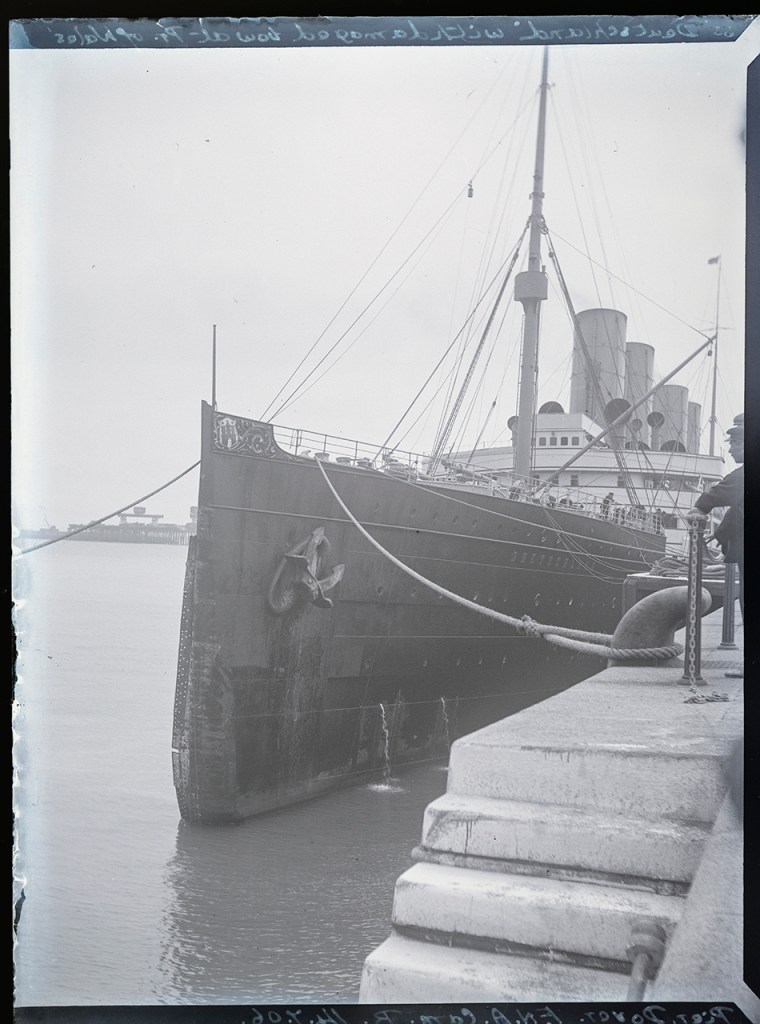
- On July 13th 1906, she damaged her bow badly after crashing into a quay in Dover. The order was given to go astern as the ship was now loaded with 1500 passengers and mail. A chain-reaction occurred as a hawser snapped and the big ship went forwards instead, straight into the quay wall. This was severe as the prow was split in two from the railings to the keel. The forepeak was flooded and the voyage was cancelled at enormous cost to Hapag. She had to be repaired for £40’000 in Southampton and she couldn’t sail during the high-season summer months.
Hapag’s verdict of the Deutschland:
Sadly, Hapag was not completely satisfied with the Deutschland by Autumn 1906. By this point a third Lloyd express steamer: the Kaiser Wilhelm II had arrived and provided impossible luxury as well as taking the eastbound Blue Riband from Hapag in June 1904. Passenger numbers and revenue were working much better for the three Lloyd steamers rather than the faster Hapag one. This all came down to a simple factor that made the Lloyd steamers more enticing than the Deutschland: passenger comfort. It didn’t matter which class you were in, Deutschland’s engines were so powerful that the whole ship: particularly the stern, was plagued by noises, vibrations and rattling. Her fuel bills were far from economical either. The Kaiser Wilhelm der Grosse when built had serious vibrations too, but that was solved after her propellors were changed. The three Lloyd express steamers had something in their hulls and machinery that the Deutschland lacked.
Hapag actually so disappointed in the ship’s economics they decided to never aim for the Blue Riband again and never built Deutschland a running-mate. They quickly phased out their express steamship sector, as the Auguste Victoria, Fürst Bismarck and Columbia were all sold off in 1904, leaving the Deutschland as their last schnelldampfer. Around this time they raised £1 million to expand their fleet with larger, but slower ships just as Ballin had always pushed for. These new ships included the Amerika and Kaiserin Auguste Victoria both of 18 knots. These vessels would prove marvellously popular, further isolating Deutschland as the 23-knot ship among Hapag’s leading vessels. Even with the disapproval of her company, Deutschland would continue to carry the Blue Riband for them even without Hapag pushing in that direction. Despite Lloyd’s efforts, they would never take the eastbound back from Deutschland.
Changing Times
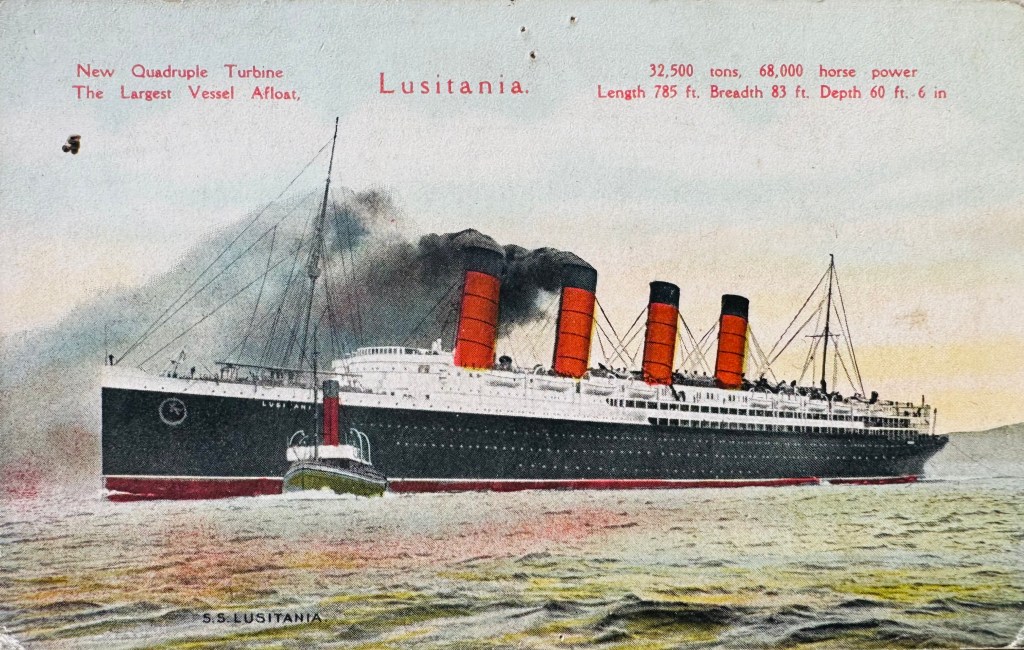
As the years of transatlantic service wore on, Deutschland steadily fell further and further behind as the time of being the most modern and technical ship in 1900 was long-gone now. She continued to hold the eastbound Blue Riband from the Kronprinz from 1903 until 1907, when the RMS Lusitania arrived with a class of speed far and away above any German vessel. She would snatch the westbound from the Deutschland and the eastbound from the Kaiser Wilhelm II easily, within two months of entering service. As mentioned, the speed record was of no importance to Hapag anymore by this point. What was important was passenger numbers and by 1907 the fourth Lloyd four-funneler: the Kronprinzessin Cecilie had arrived and this quartet was immensely popular in a way Deutschland could never match.
Deutschland sadly didn’t really have a place in Hapag’s fleet anymore, and rumours began to spread that the ship was going to be sold to Russia around the late 1900’s. Deutschland continued to sail until 1908 when she was suddenly sent in for a lengthy refit and completely reboilered. Reports believed Hapag was going to massively speed up Deutschland again and make her capable of surpassing the RMS Mauretania’s insane 26-knot speed. This was absolutely not the truth, but Deutschland’s new boilers actually were still problematic just like her old ones. With no other solution left, Deutschland only maintained regular transatlantic service until 1910. Her time wasn’t done yet, Hapag had a big idea for the ship and she would amaze the world once again after they had breathed new life into her with a new role.
SS Victoria Luise
Conversion Job:
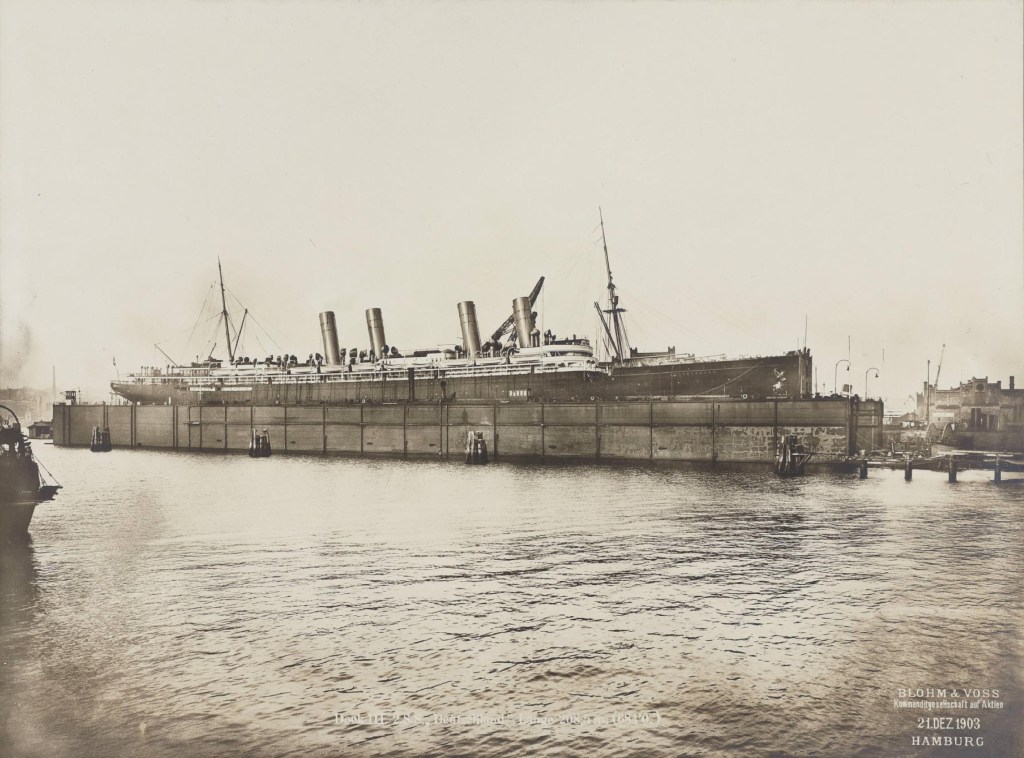
In October 1910 Deutschland left regular transatlantic service forever to be converted into one of the world’s first full-time cruise ships. She went back to the Vulkan shipyard for a massive, almost year-long conversion job. Her meddlesome engines, that had troubled her entire career due to their immense power were finally silenced. They were completely “rebuilt” into 4-cylinder quadruple expansion jobs, which kept the stroke, but completely changed the sizes of the cylinders. Her aft boiler rooms were completely gutted, removing the need for her last two funnels, but she still kept all four to maintain her sleek profile. In total, with only half the boiler power she once had, Deutschland’s new top speed was 19 knots as compared to her once 23.
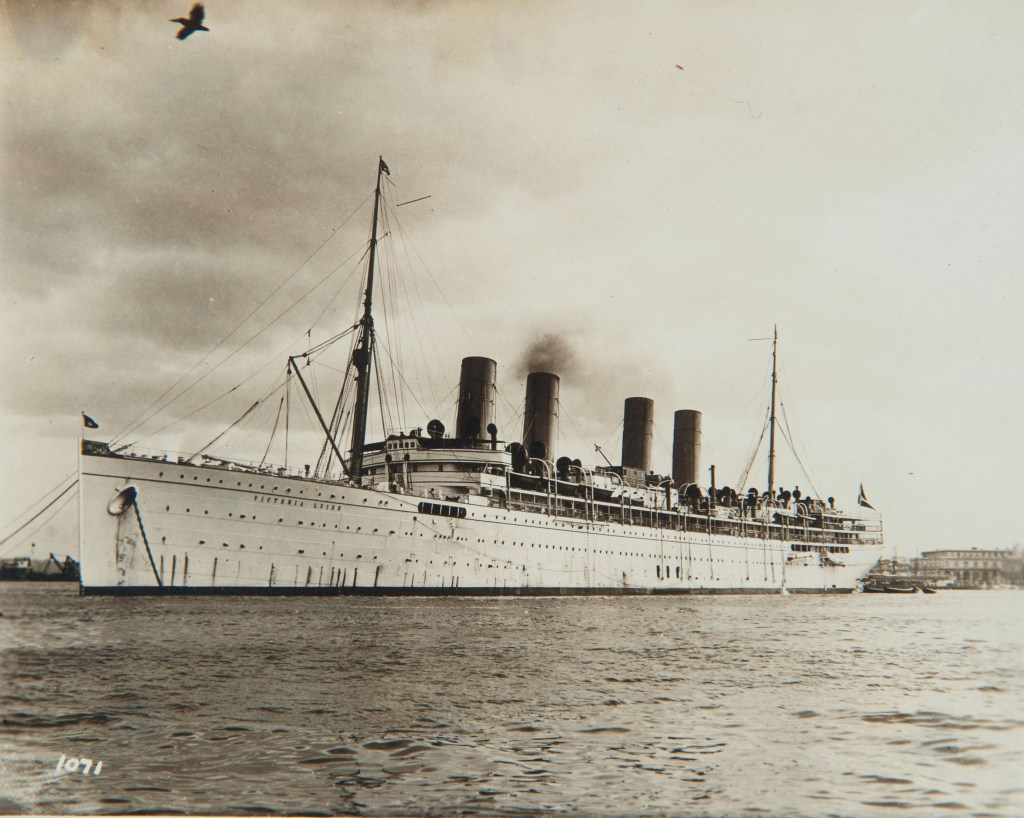
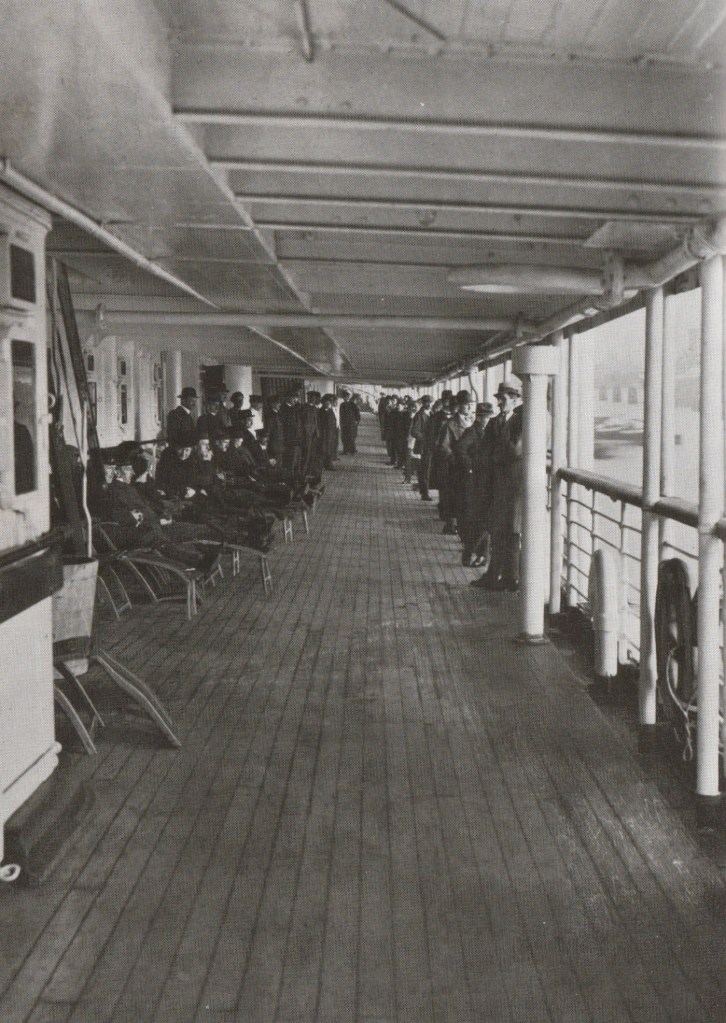
High speed was not required for cruising, but a pleasant passenger experience was the most crucial detail. With heavy measures haven been taken to finally eradicate her vibrations, her rolling was also remedied with anti-rolling tanks that were placed behind the positions of her aft funnels. Her forward well deck was covered over, but still open at the sides. Her Boat Deck was extended all the way to her stern and had another deck placed above it. She was completely repainted in white cruising colours and had her lifeboats replaced by more powerful motor-types made from mahogany. Spaces that had originally designated for cargo were gutted to allow space for more passenger accommodations. She was now a First-Class ship only, with 500 passengers in total and her Third-Class accommodations were completely gutted. With all these modifications, the ship’s tonnage rose to 16’703 GRT. Now being reborn as a completely new ship, she was given a new name too: SS Victoria Luise.
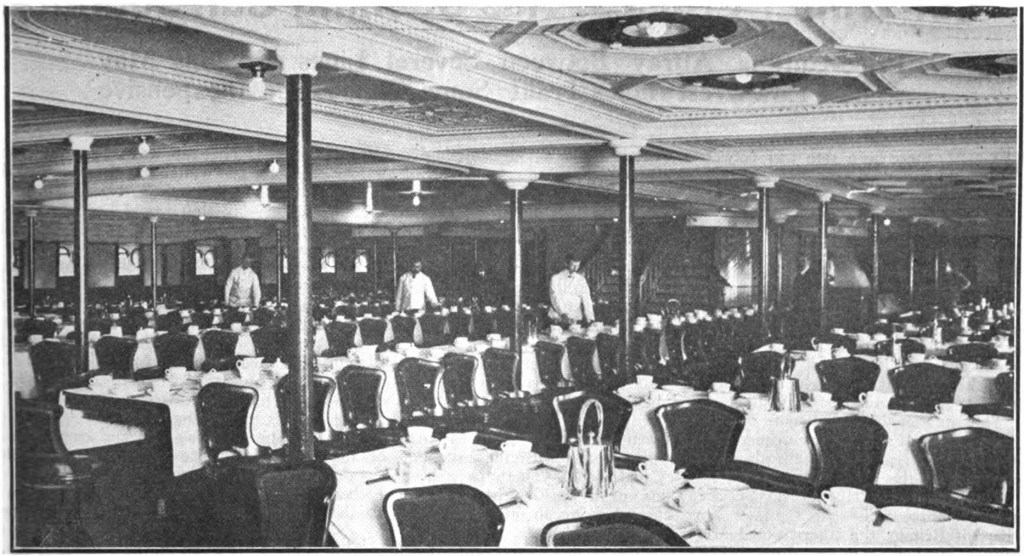
New onboard features the Victoria Luise brought with her included a gymnasium that was installed into what was once the Second Class Smoking Room. Her First Class Dining Saloon was also remodelled and decorated and could now accommodate every single passenger on the voyage at the same time. She received electric-lighted baths, a photographer’s dark room, swimming pool, library, bookstall, and information bureau. By far, SS Victoria Luise was the largest and most luxurious cruise liner on the planet when she commenced sailing in September 1911.
Victoria Luise Interiors
The Grandest Cruise Ship in the World
Setting sail
On the 1st September 1911 the Victoria Luise left Hamburg towards the North Sea to undergo sea trials once more, as a brand-new ship. In the force of strong winds, the ship was pushed to 15’000 hp and achieved a speed of 18.7 knots with an absolute maximum of 19. The ship was performing exactly as expected, but she still vibrated lightly at her fore and her bridge. This wasn’t the end of the world as that was at max speed. When she sailed at her usual output of 12’000 hp you could hardly feel anything. With the ship now satisfactory, she departed successfully for her first new commercial voyage on the 23rd September from Hamburg to New York and back with a compliment of 531 passengers. Unfortunately her second voyage was marred by powerful force-10 which angered her passengers as they only got to enjoy a single day of good weather onboard this cruise ship. The ship still performed well, she took about 8 days to cross the Atlantic now and her coal intake was a far more economical 220-260 tons daily. Her old nemesis of vibration was also nearly completely absent with several rooms such as her Smoking Room, Ladies Room and Dining Saloon experiencing absolutely none for the first time in the ship’s operating history.
Cruising for the elite
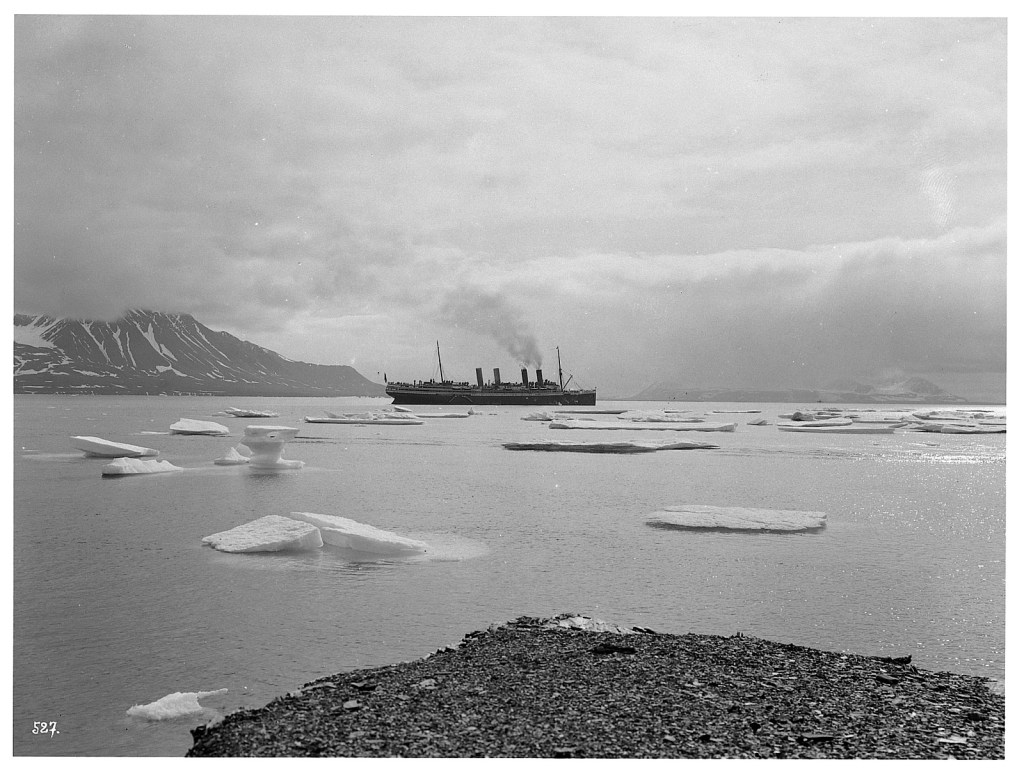
On the 7th February 1912, the Victoria Luise left the American coast for her first proper cruise to the Caribbean Islands with 460 guests aboard. This 25-day trip would include: Havana, San Juan, Kingston, La Guaira, Trinidad, Barbados, Martinique and St. Thomas with her last stop finishing in New York on the 4th March. She would make 3 West Indies cruises total in Spring 1912 as well as another transatlantic to New York. On the 19th June this year, she would also take part in the celebrations of Kieler Woche and the annual fleet review. She would host 250 esteemed guests of the Hapag as a pure floating hotel. During a later transatlantic crossing a colossal, three-day storm wrought the ship, but she remained stable with nearly-empty ballast tanks and had little rolling. Even then, this was one of the hardest challenges the ex-Deutschland had ever fought as cabins were flooded, and the voyage was so delayed the ship only had 10 tons of coal remaining upon arriving in New York. Things would get better as she would later take a cruise to Northern waters from the 2nd-27th July 1912, and be met by perfect weather and a very successful voyage. And then immediately afterwards, another Northern cruise saw the ship’s machinery underperforming, stuck in a terrible gale, and being blown far off course whilst also only being able to hit around 12-14 knots.
The Victoria Luise would always persevere howver, and was a very worthy successor to Hapag’s previous cruising queen: the Oceania. Her cruises and occasional transatlantic crossings proved to be very popular.
Kieler Woche 1914 and the declaration of War
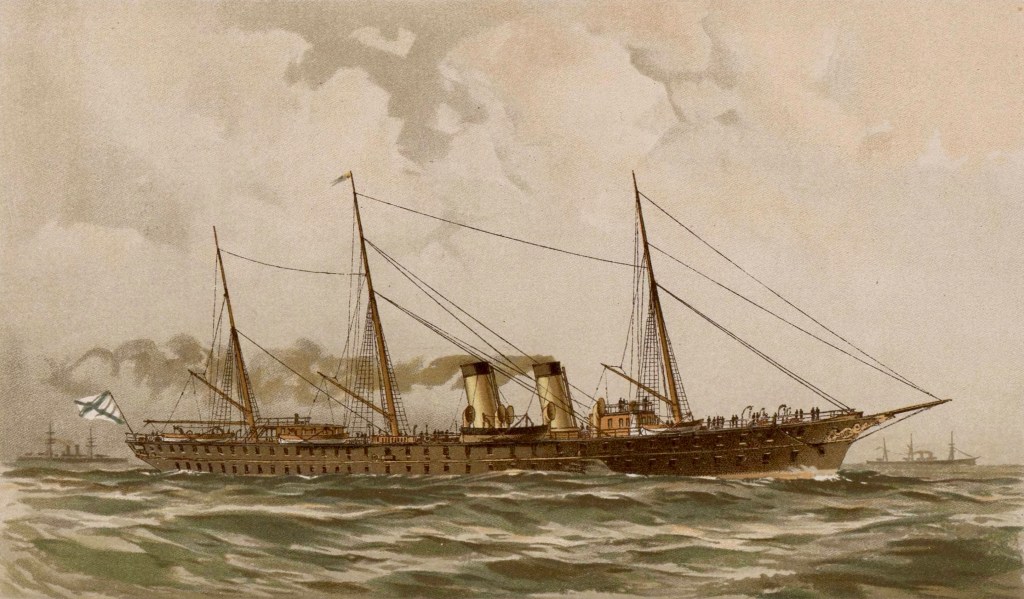
An officer of the Victoria Luise: Count Alfred von Niezychowski recounted the last few days before Franz Ferdinand was killed, and the Great War would begin. On June 23rd 1914 just 5 days before the assassination that changed the world, the Victoria Luise was taking part in the Elbe regatta, and was the grandstand of the fleet. On this day the Imperial yacht: Hohenzollern met with the Victoria Luise and took aboard Kaiser Wilhelm II himself and his consort which included: Prince Lichnowsky, German ambassador of London, Count Pourtalés, German ambassador of St. Petersburg, Prince Wiedel, commander of Alsace Lorraine, other nobles such as Barons von Dincklage and Hengenmüller and many more. That night after a great party, the Kaiser gave a speech in the dining saloon. The concluding words that would be met by thunderous applause were:
“We Germans fear no one on Earth, only God.”
The Kaiser would leave the next day for Kiel. The Victoria Luise also steamed onwards to Kiel, to take part in the great festival and fleet review. On June 25th the Polyarnaya Zvezda, the royal yacht of the Russian Czar passed the Victoria Luise. There was considerable tension among the officers as they knew the Polyarnaya Zvezda was returning from St. Petersburg with French diplomats who had been to the capital to sign agreements between France and Russia. These were heavily rumoured to be related to war. On the 26th June the Victoria Luise arrived in Kiel for the festival and was to be the reception ship of the Hamburg American Line. She steamed to the centre of the harbour decked in flags and freshly repainted, surrounded in a giant semi-circle of yachts, warships, passengers ships with most prominently: the German, British, French, American, Italian and Japanese Navies.
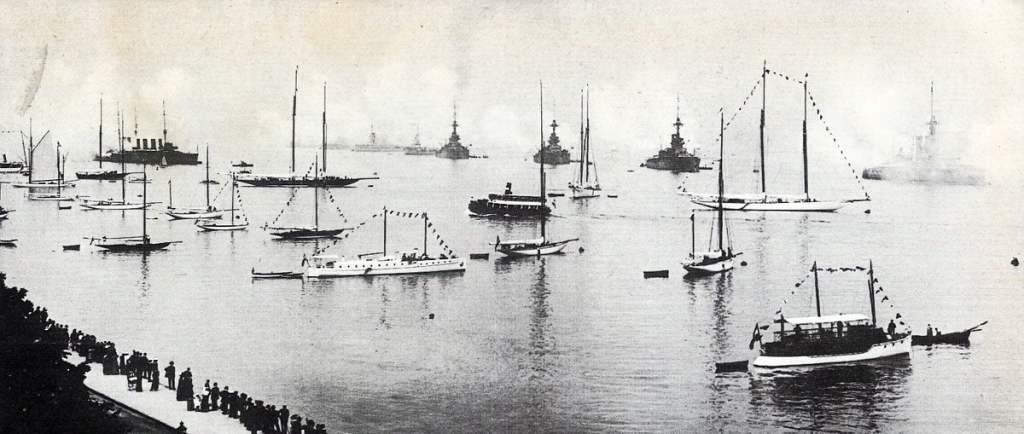
Festivities continued over the next two days. On the 27th of June, the Victoria Luise was selected to receive Kaiser Wilhelm II again to host the royal reception and ball. The entire harbour was packed, with crowds, balloons, bands, pennants, music and the like. Another ball was held this night aboard the Victoria Luise including the nobility of many countries. Just the next day, the festivities would be silenced permanently. At 12:00 on the 28th June 1914, Archduke Franz Ferdinand of Austria and his wife were assassinated in Sarajevo 1 thousand miles away. By 1pm, this news had reached the Victoria Luise and was telegraphed to the German ambassador of Hungary, who was aboard. Two destroyers quickly came to the Victoria Luise, and took the most important guests to the yacht Meteor where the Kaiser was. As soon as he received the news, he ordered the festivities to stop in a husky voice.
All battleships had their flags lowered to half mast and the entire harbour was wiped of the colour it once had. Then the mourning salutes began as the roughly 100 German warships began firing their 60 rounds. With this, the hundreds of ships all began to leave and by the next morning there was not a trace of the festival of Kiel left. The ship was then ordered to sail to Hamburg.
The Outbreak of War
The First World War was officially declared exactly one month after Franz Ferdinand was assassinated, -on the 28th July 1914. At this time, Hapag’s fleet was sprawled across the globe with the oceans officially unsafe to navigate. This did not apply to the Victoria Luise as she was one of the lucky ones still back at Hamburg, along with the Imperator, Kaiserin Auguste Victoria, Cleveland, Graf Waldersee, Batavia, Patricia, Bosnia, Rugia and Pallanza.
SS Hansa, a Shadow of the Deutschland
SS Hansa Interiors

On the 28th May 1925, the Hansa was sold to the Vulcan Shipyard
Bibliography
- Kludas, Arnold (2000) Record Breakers of the North Atlantic, Blue Riband Liners 1838 – 1952 Chatham Publishing, London.
- Isherwood, J. H., (1962) Sea Breezes, November 1962 (“Deutschland of 1900”)
- Sander, Styllz (2020) The World of German Liners: https://www.worldofgermanliners.com/deutschland (Accessed: March 2025)
- Miller, William H. (1989) German Ocean Liners of the 20th Century Patrick Stephens Limited, Avon.
- Rothe, Claus (1986) Deutsche Ozean-Passagierschiffe 1896 – 1918 Verlag für Verkehrswesen Berlin.
- Norway Heritage “S/S Deutschland (3), Hamburg America Line“: https://www.norwayheritage.com/p_ship.asp?sh=deutc (Accessed: March 2025)
- Witthöft Jürgen, Hans (1978) Männer, Schiffe, Schicksale Band 3: Nordatlantik-renner Koehlers Verlagsgesellschaft, Hamburg.
- Shaum Jr, John H. & Flayhart III, William H. , (1981) Majesty at Sea, The Four Stackers, W.W. Norton and Company, New York London
- Niezychowski, Alfred von (1928) The Cruise of the Kronprinz Wilhelm, Selwyn and Blount, London
- Kludas, Arnold (1987) Die Geschichte der Deutschen Passagierschiffart Band II: Expansionen auf allen Meeren 1890 bis 1900. Ernst Kabel Verlages, Hamburg.
- EMPEROR WILLIAM’S BIRTHDAY. New York Times, January 28th 1904, p.6
- GERMAN LINER LAUNCHED. New York Times, January 11th 1900, p.7 https://www.nytimes.com/1900/01/11/archives/german-liner-launched-the-emperor-sees-the-deutschland-enter-the.html?searchResultPosition=3
- Totzke, Thorsten https://lostliners.de/schiffe/d/deutschland/geschichte/index.htm (accessed June 7th 2025)
- Rothe, Claus & Schödler, Jürgen (1997) Die Deutschen Traumschiffe Koehlers Verlagsges.
- Bonsor, N. R. P. (1975) North Atlantic seaway : an illustrated history of the passenger services linking the Old World with the New. Arco Publishing Co. New York
 The Kaiserhafen
![[i]](https://commons.wikimedia.org/wiki/File:Dampfschiff_Deutschland_03.jpg)
![[i]](https://commons.wikimedia.org/wiki/File:Dampfschiff_Deutschland_01.jpg)
![[i]](https://commons.wikimedia.org/wiki/File:Cassiersmagazi161899newy_0583.jpg)
![[i]](https://commons.wikimedia.org/wiki/File:Marineengineerin51900newy_0303.jpg)
![[i]](https://commons.wikimedia.org/wiki/File:Marineengineerin51900newy_0424.jpg)
![[i]](https://commons.wikimedia.org/wiki/File:Marineengineerin51900newy_0422.jpg)
![[i]](https://commons.wikimedia.org/wiki/File:Collectie_Nationaal_Museum_van_Wereldculturen_TM-60061879_Cruiseschip_%27Victoria_Luise%27_Caraibisch_gebied_fotograaf_niet_bekend.jpg)
![[i]](https://commons.wikimedia.org/wiki/File:Russian_Fleet_crop_01.jpg)
![[i]](https://commons.wikimedia.org/wiki/File:Kieler-Woche-1914-brit-Geschwader.jpg)