

A History of Funnel Count:

(Author’s Collection)
The four-funnelled liners or “four-stackers” contain some of the most prestigious and iconic vessels ever built. There were fourteen of them purpose-built in total, with several of the most favourite being: RMS Olympic, RMS Lusitania, RMS Mauretania, SS Kaiser Wilhelm der Grosse and many more. Just the mere presence of these vessels, that would absolutely tower over all other ships in any harbour and catch anyone’s eye immediately, were also some of the most well-known of their time too. Many people also knew of the fifteenth member of this group: the SS Great Eastern, that had boasted a ridiculous five funnels upon introduction but was later reduced to four during its 30 year career. Great Eastern was the only five-funnelled ocean liner ever built and many do not speak in favour of her appearance, generally believing the ship to be too excessive. This is a sharp contrast to the four-stackers as ships like Olympic and Lusitania are very widely-regarded as some of the most beautiful ever built. It seems impossible to think another five-stacker would ever exist after the Great Eastern, especially by the 1900’s, but one actually did, albeit on paper.
A Quartet of Luxury Express-Steamers
In the early 1900’s the North German Lloyd Steamship Company was sweeping the headlines with their duo of high-speed liners: the sisters SS Kaiser Wilhelm der Grosse and SS Kronprinz Wilhelm. These two steamers could cross the Atlantic in six days and were some of the most-sought and popular on this route. It was no wonder that a third had to join them and provide even greater luxury. This ship started construction in 1901 and was to become: the SS Kaiser Wilhelm II. This ship was a larger and modified version of the Kronprinz Wilhelm, but it would need a running mate too. With a full quartet of express liners, the Lloyd would provide a high-speed service that none of their competitors could challenge. Building this last, great ship was crucial, and the Director of the Lloyd: Heinrich Wiegand and his management staff were left with a very difficult decision on how this ship should be built. The exact same difficult choice had been made 15 years when previous Director Lohmann had ordered the Kaiser Wilhelm der Grosse and catapulted their successes until now.
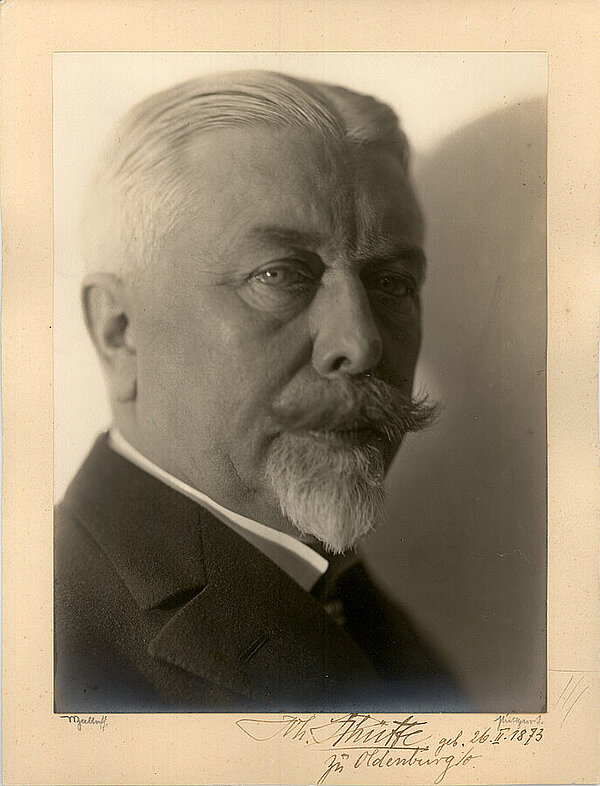
Johann Schütte
The Kronprinz Wilhelm and Kaiser Wilhelm II weren’t always intended to succeed the Kaiser Wilhelm der Grosse, but the SS Kaiser Friedrich was. This liner had set sail in May 1898 to be the second liner in Lloyd’s express service but it underperformed terribly, missing it’s 22-knot service speed for Lloyd to accept it. Things were not well within the company now as their biggest rival: Hamburg Amerika Line had the time to put forward their own express liner: the SS Deutschland in 1900 and the Kaiser Wilhelm der Grosse was stuck sailing without a running-mate. Immediately after the failure of the Kaiser Friedrich, the Lloyd hired the young German engineer Johann Schütte to examine the reasons why both of their express steamers performed so differently. He tested water models in La Spezia and his results led him to build the famous facility in Bremerhaven where these tests could be done. Schütte paid particular attention in understanding resistance of ships against water and using these findings, he gave himself a goal when designing the next great Lloyd liner in 1902.
The Schütte Liner

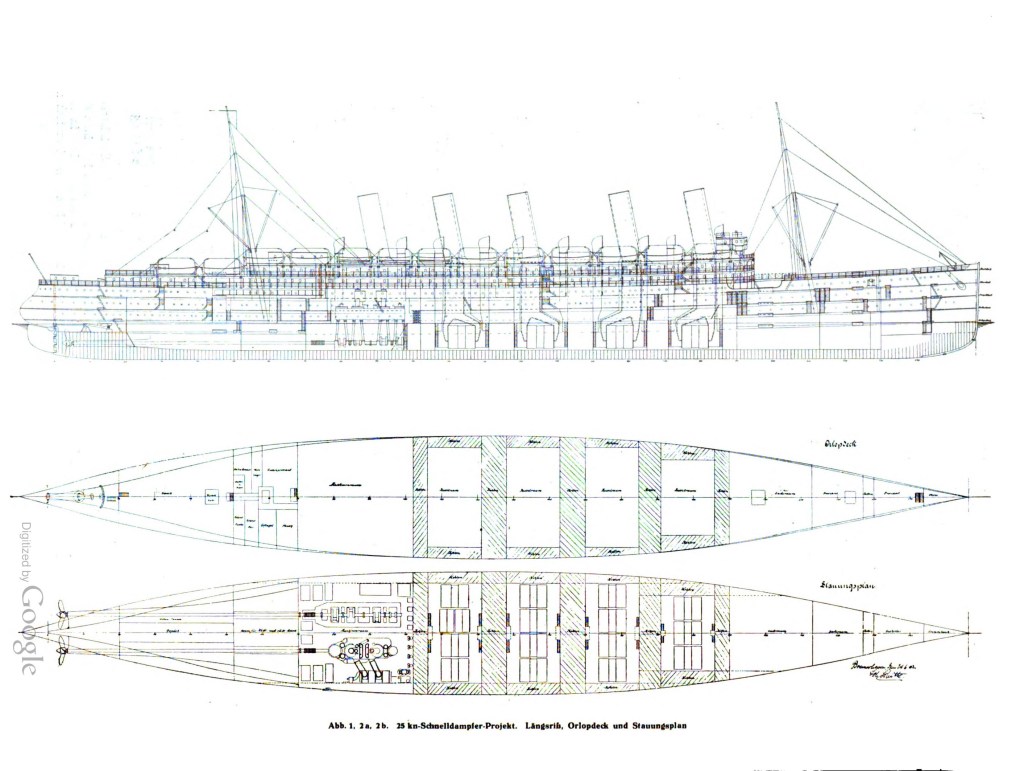
Schütte’s goal was for a liner that could reach an unprecedented 25.5 knots, whilst being the same size and having the same power as the Kaiser Wilhelm II. If it existed this ship would be in a league above any other, sailing a full 2 knots above the fastest ship in the world: the Deutschland with her 23.5 knots. His secret in achieving this lay in the ship having a cruiser stern, shallow draught and a much wider hull which would make her slice through the water like butter using the same engines as her predecessor. With this immense speed, Schütte’s liner could cross the Atlantic in five days compared to the six of her predecessors, which would allow passengers to reach the evening trains in New York, and get connected far faster. This ship would boast an amazing five funnels and a strong resemblance to the Kaiser Wilhelm II, but was different in other substantial ways.
Deck Plans of the Schütte Liner
Cancellation
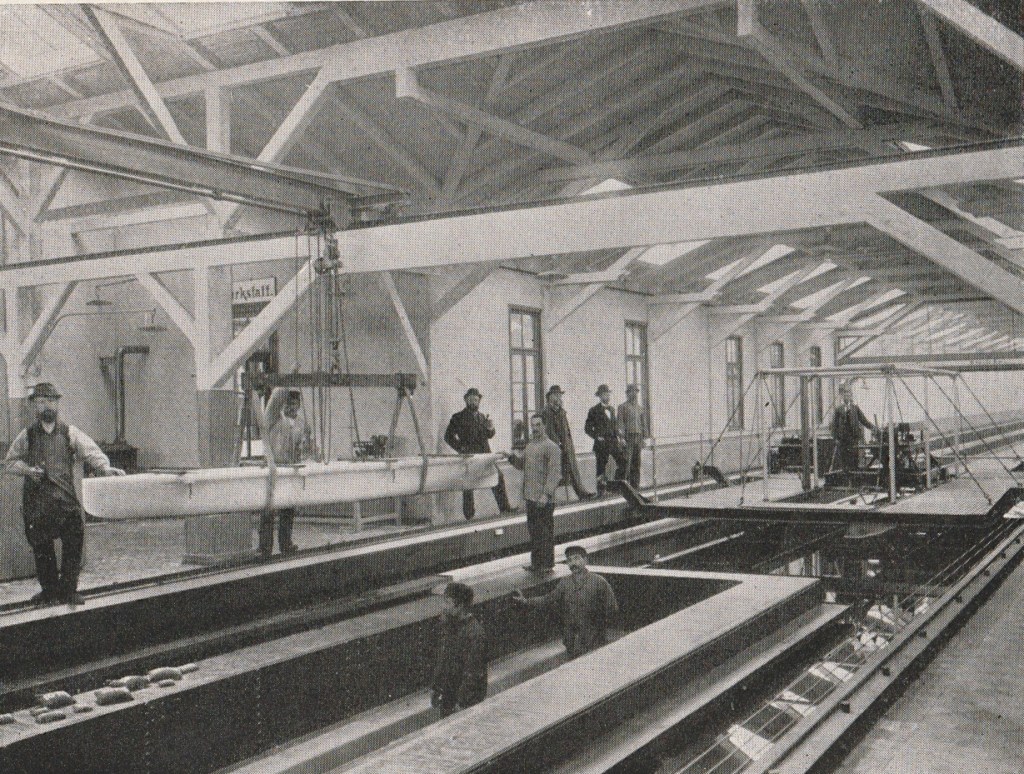
(Author’s Collection)
It is difficult to tell how serious NDL was on accepting this design and building this ship. British authors believe this project never came to be because NDL was aware of the Cunard Line planning the Lusitania and Mauretania whose speed could likely exceed the Schütte liner. Others have suggested that construction difficulties led to the plan being abandoned. Another factor that certainly had an effect on designing this project was the Kaiser Friedrich. F. Schichau, the shipyard that had built this vessel had assured the Lloyd that the vessels smaller size would allow her to reach the correct speed despite the lower engine power. This was an experiment, and Lloyd paid for it which is why they rejected the ship. After that fiasco, they adopted a policy of “No more experiments” when designing new liners and would now use tried-and-tested methods instead. Even if the Schütte liner came into reality and was every bit as great as designed, she fitted into no NDL timetable and they didn’t have a running mate for her either.
Other questions that remain are why an efficient engineer like Schütte chose to gave the liner five funnels, as it is uncertain if the fifth was a dummy. It could have simply been for aesthetic reasons but as mentioned, five funnels were not looked at too keenly and people would think badly of Schütte’s tastes. Perhaps adding a third mast like that of the Kaiser Wilhelm II would better balance the liner. A popular legend states that passengers judged the safety and speed of a liner by the amount of funnels it had. Room and facilities on smaller liners were often poor for the average person, so a ship with four funnels had to be bigger and faster than a ship with one.
| Name | GRT | Length (Overall) | Width | Max Horsepower | Max Knots | Total Passengers |
| Kaiser Wilhelm II | 19’361 | 215.34m | 22.05m | 38’000 | 23.5 | 1535 |
| The Schütte liner | 20’700 | 209.8m | 27.00m | 39’000 | 25.5 | 1950 |
The Kronprinzessin Cecilie
Even though the Schütte liner only ever existed on paper, the running mate to the Kaiser Wilhelm II and completion to the quartet was very much a real liner. She came into existence sailing her maiden voyage on the 6th August 1907. She was a close sistership to the Kaiser Wilhelm II as that vessel had already proved its popularity and capabilities since entering service in 1903. On her sea trials the Kronprinzessin Cecilie performed at a phenomenal speed of 24.02 knots. Thus Lloyd got their quartet in the end, finishing with a ship that was more powerful and luxurious than any that they had.
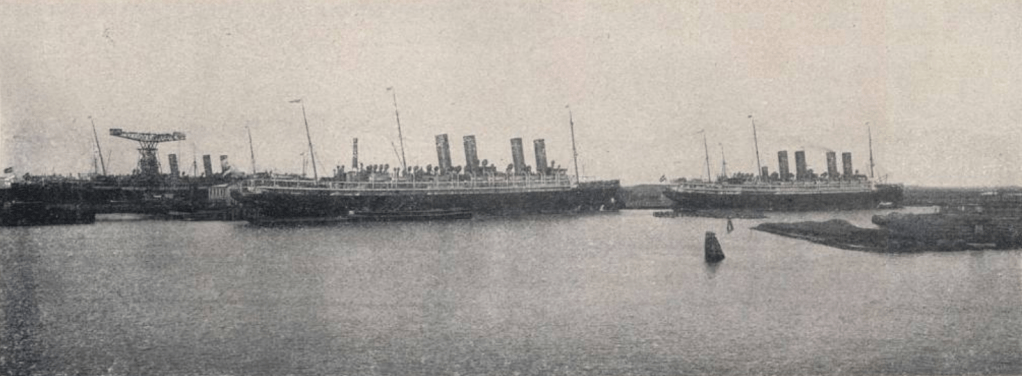
 The Kaiserhafen